You’ve witnessed those mesmerizing beams cutting through darkness at concerts and clubs, but understanding the sophisticated technology behind party laser systems reveals why they’ve become indispensable for creating unforgettable atmospheres. These aren’t simple light sources—they’re precision instruments employing semiconductor diodes, galvanometer mirrors, and complex beam manipulation techniques to generate coherent light that dances with mathematical precision. The intricate interplay between wavelength control and atmospheric enhancement creates something far more compelling than meets the eye.
The Science Behind Laser Light Technology
When you activate a laser light system, you’re witnessing the controlled emission of coherent photons through stimulated emission of radiation—the very principle that gives lasers their name.
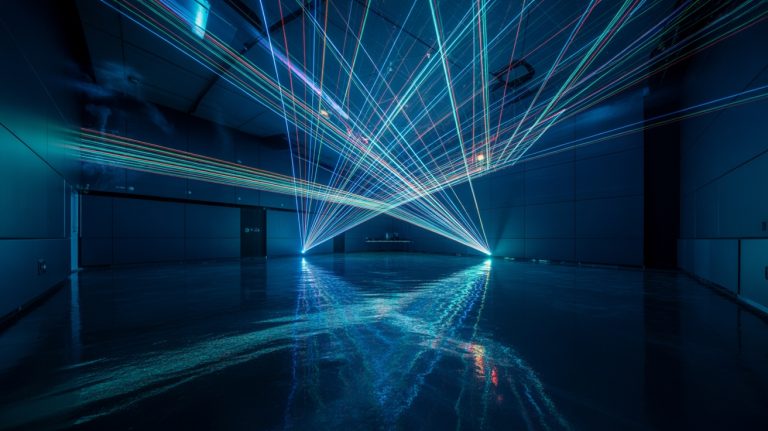
You’ll find that party lasers typically utilize semiconductor diodes that generate monochromatic beams with exceptional spectral purity. These coherent light waves maintain consistent phase relationships, creating the distinctive sharp beams you see cutting through atmospheric particles.
Your laser projector employs galvanometer-driven mirrors that execute precise angular movements, redirecting beams at frequencies reaching 30,000 points per second. This rapid scanning creates complex geometric patterns and animations.
You’re experiencing wavelength-specific colors—650nm produces red, 532nm generates green, and 445nm creates blue. Modern RGB systems combine these wavelengths, enabling you to project millions of color variations with stunning beam divergence control.
Types of Laser Systems for Entertainment
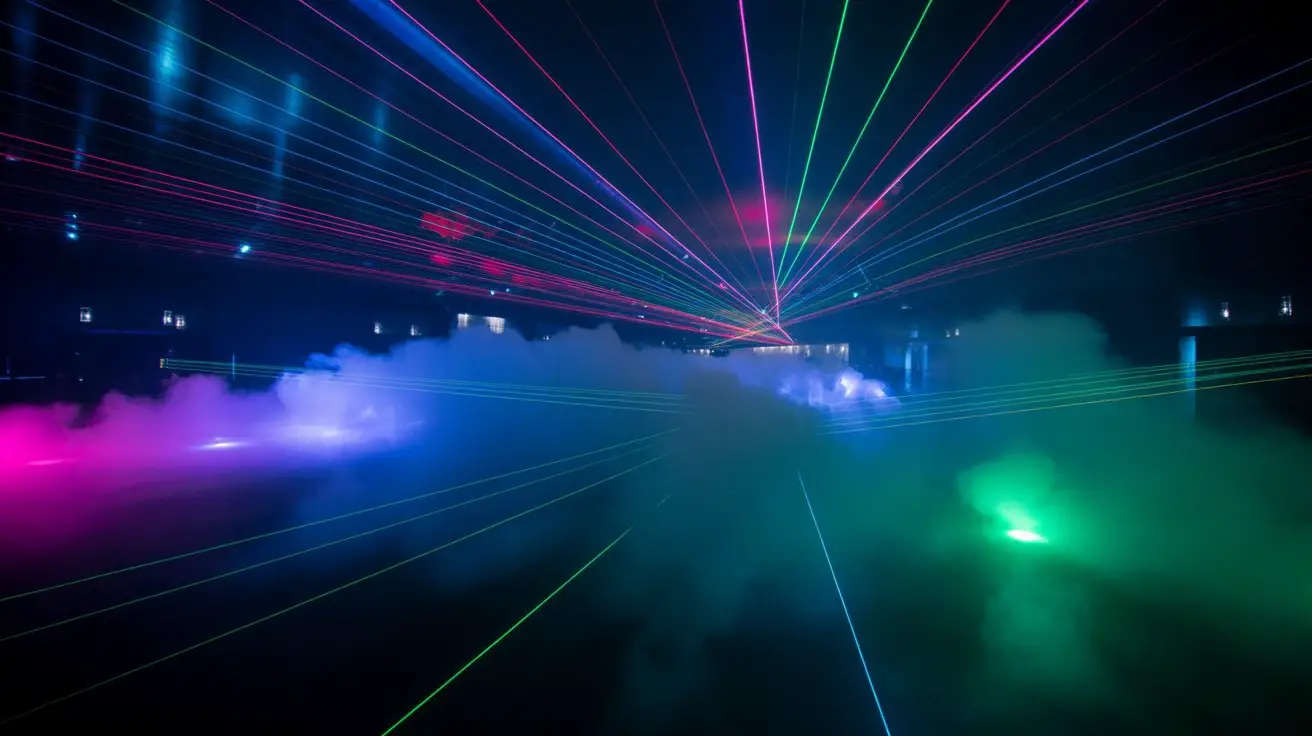
Entertainment laser systems fall into distinct categories, each engineered for specific performance requirements and venue scales.
You’ll encounter sophisticated beam projectors, pattern generators, and multi-wavelength arrays designed for professional applications.
Understanding these classifications helps you select ideal equipment:
- Geometric Pattern Projectors – Create precise shapes, tunnels, and architectural effects using galvanometer-controlled mirrors for rapid beam positioning.
- Atmospheric Beam Systems – Generate visible light columns through fog or haze, utilizing high-powered diodes for maximum visibility.
- RGB Full-Color Arrays – Combine red, green, and blue wavelengths for unlimited color mixing and dynamic spectrum control.
- DMX-Controlled Networks – Enable synchronized multi-unit operations through standardized lighting protocols for complex installations.
Each system incorporates safety interlocks, thermal management, and modulation circuits.
You’ll find power ratings ranging from a few milliwatts in consumer units to 40-watt professional installations, with beam divergence specifications determining coverage area.
Essential Components of Party Laser Equipment
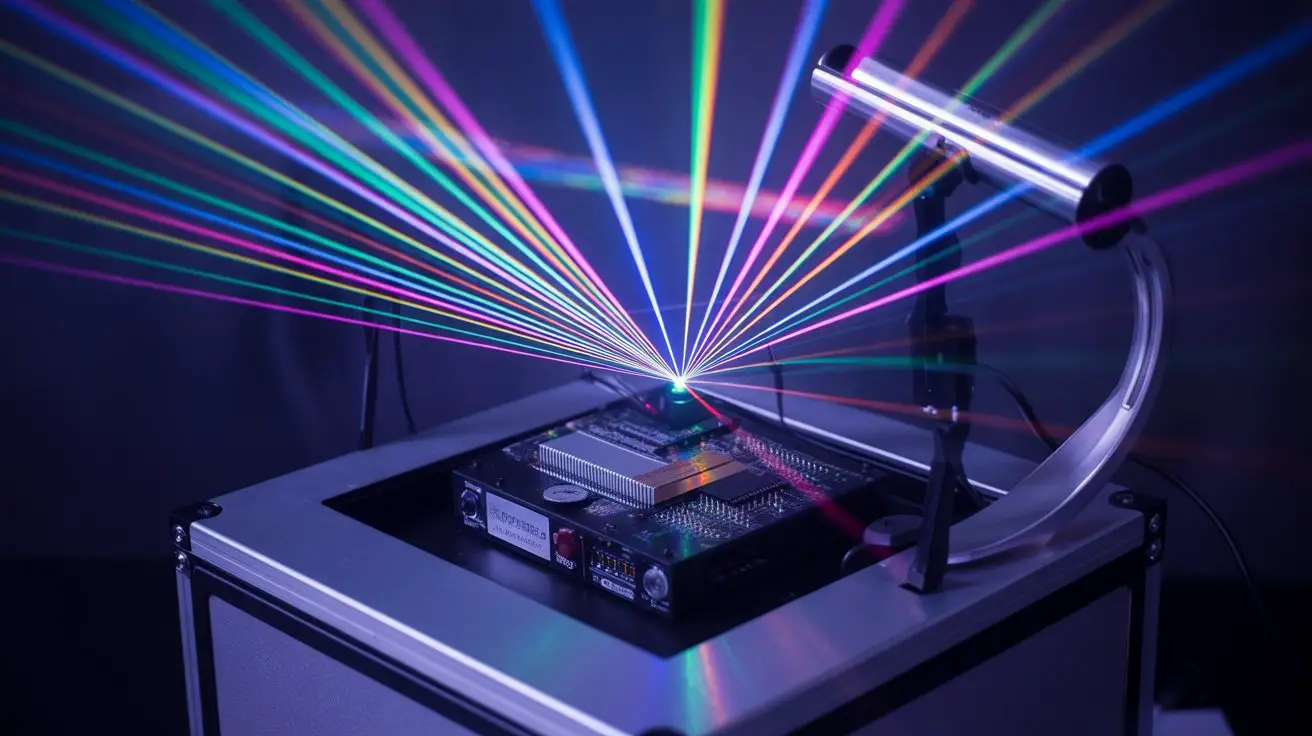
Modern party laser systems comprise several interconnected components that transform electrical energy into spectacular light displays.
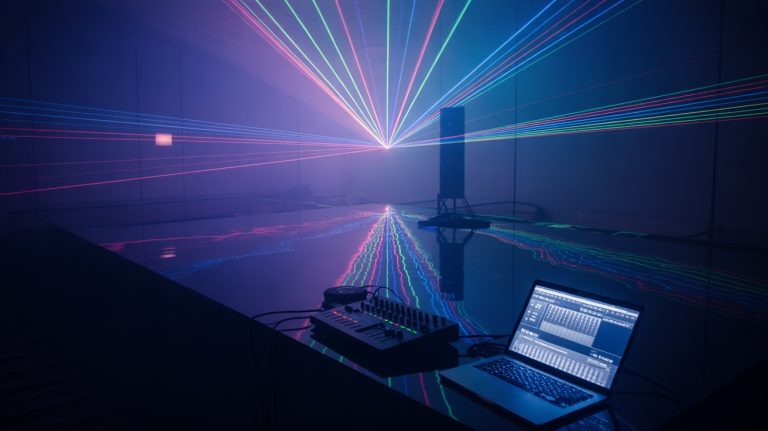
You’ll find the laser diode serves as the heart, generating coherent light through stimulated emission. The galvanometer scanner system controls beam direction using precise mirror movements, creating patterns and animations across surfaces. Your DMX controller interfaces with lighting software, enabling synchronized sequences and real-time adjustments during performances.
The optical assembly includes collimation lenses that focus beam intensity and dichroic filters for color mixing.
You’ll also need safety features like key switches, emission indicators, and beam stops to comply with FDA regulations. Professional units incorporate ILDA compatibility for standardized control protocols.
The power supply regulates voltage distribution, while the cooling system prevents overheating during extended operation, ensuring consistent performance throughout your event.
Color Generation and Beam Manipulation Techniques
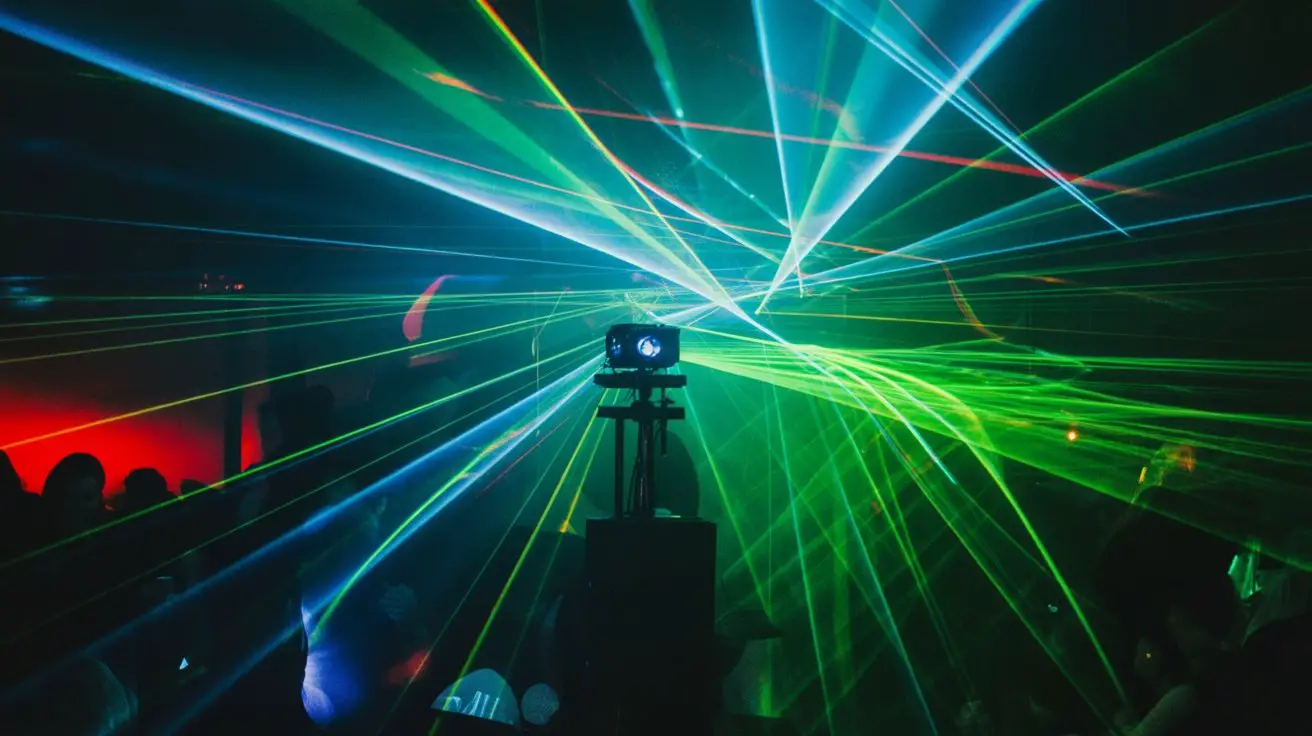
While basic laser diodes produce monochromatic light, today’s party systems achieve vibrant color spectrums through sophisticated optical manipulation techniques.
You’ll find these systems employ dichroic filters, beam combiners, and crystal matrices to transform single-wavelength sources into dynamic multi-color displays.
Modern beam manipulation utilizes several key technologies:
- Dichroic Beam Combining – Merges red, green, and blue laser sources through precision-aligned optical elements
- Galvanometer Scanning – High-speed mirrors redirect beams at thousands of positions per second
- Diffractive Optics – Specialized gratings split single beams into complex geometric patterns
- Color Wheel Systems – Rotating filters create temporal color mixing for budget-conscious applications
You’ll discover that professional controllers synchronize these elements through DMX protocols, enabling precise color temperature adjustment, saturation control, and beam positioning that responds dynamically to musical triggers.
Safety Considerations and Regulations
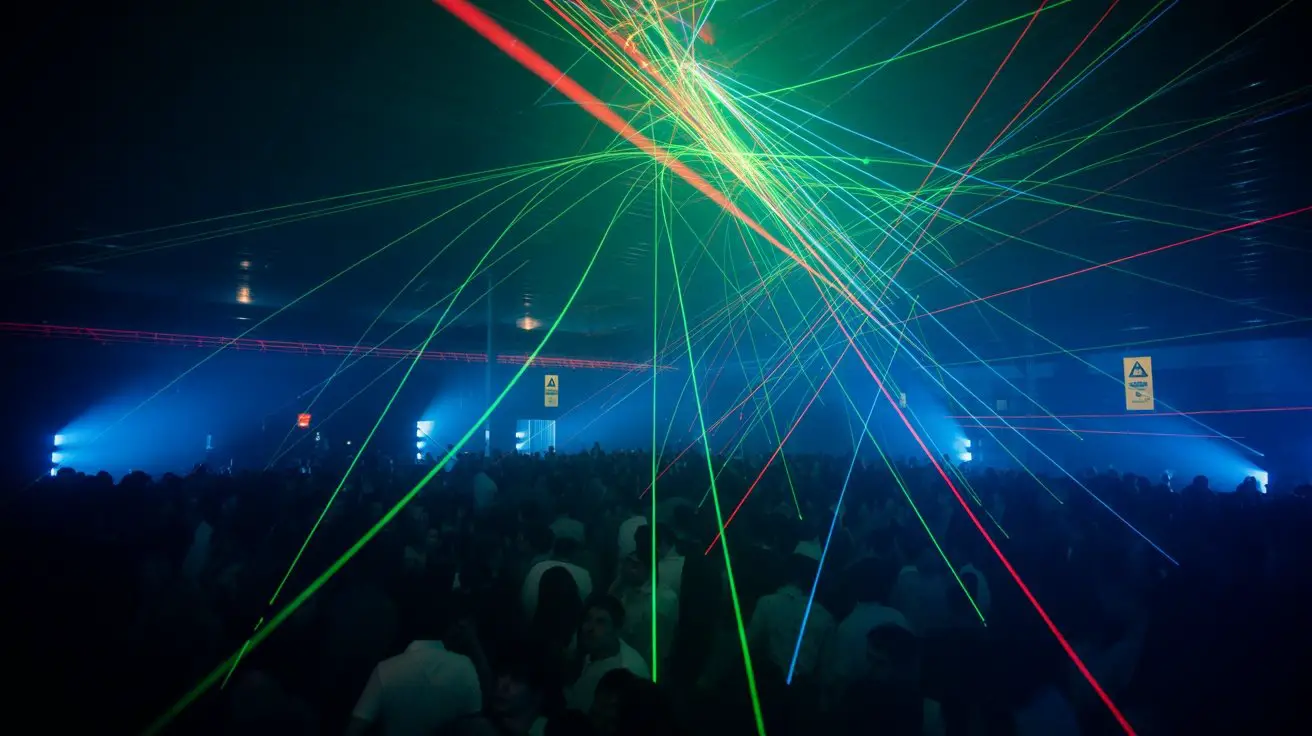
Because laser light systems can generate intense electromagnetic radiation capable of causing permanent retinal damage, you must understand the stringent classification protocols and protective measures that govern their operation.
Class 3B and 4 lasers require specialized handling procedures, including designated safety officers and controlled access zones.
You’ll need FDA compliance for entertainment venues, ensuring beam termination above audience areas and maintaining minimum viewing distances.
Install emergency shutoff systems and warning signage throughout your installation perimeter.
Never direct beams toward aircraft corridors or reflective surfaces that could redirect radiation unexpectedly.
In the US, FDA guidance keeps show beams at least 3 meters (about 10 feet) above the floor where the audience stands.
You must also implement audience scanning protocols that prevent direct eye exposure while maintaining the dynamic visual effects that make your events spectacular.
Programming and Synchronization With Music
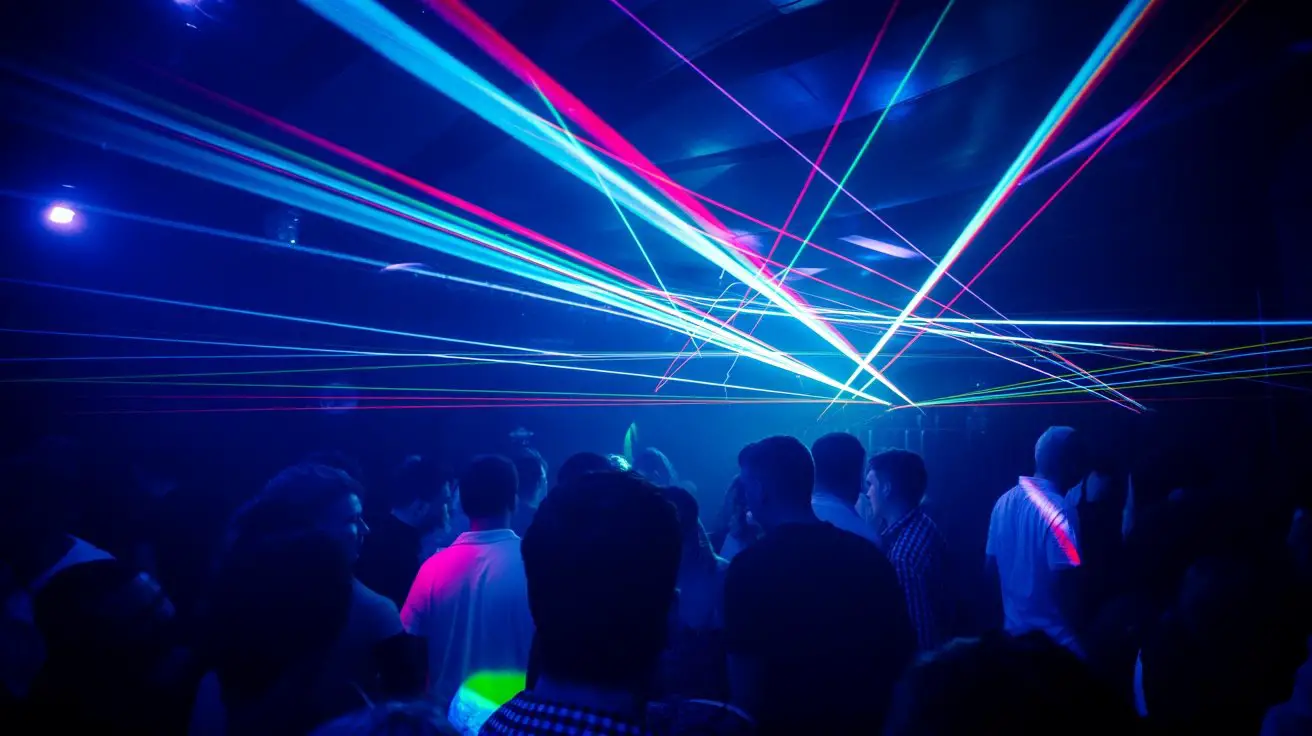
Programming your laser light system to synchronize with music transforms static beams into dynamic visual narratives that pulse, sweep, and cascade in perfect harmony with every beat and melody.
Modern laser controllers utilize sophisticated algorithms to analyze audio frequencies, automatically triggering specific patterns based on bass drops, vocal peaks, and rhythmic sequences.
You’ll achieve ideal results by mapping your laser’s DMX channels to correspond with your music’s tempo and intensity variations.
Consider these essential programming techniques:
- BPM Matching – Calibrate your laser’s cycle rate to match your track’s beats per minute
- Frequency Filtering – Assign different beam patterns to bass, mid-range, and treble frequencies
- Manual Override – Program custom sequences for dramatic musical climaxes
- Fade Changes – Create smooth visual bridges between contrasting musical sections
Professional lighting software enables real-time adjustments, ensuring your laser display remains perfectly synchronized throughout your event’s duration.
Choosing the Right Laser Setup for Your Event
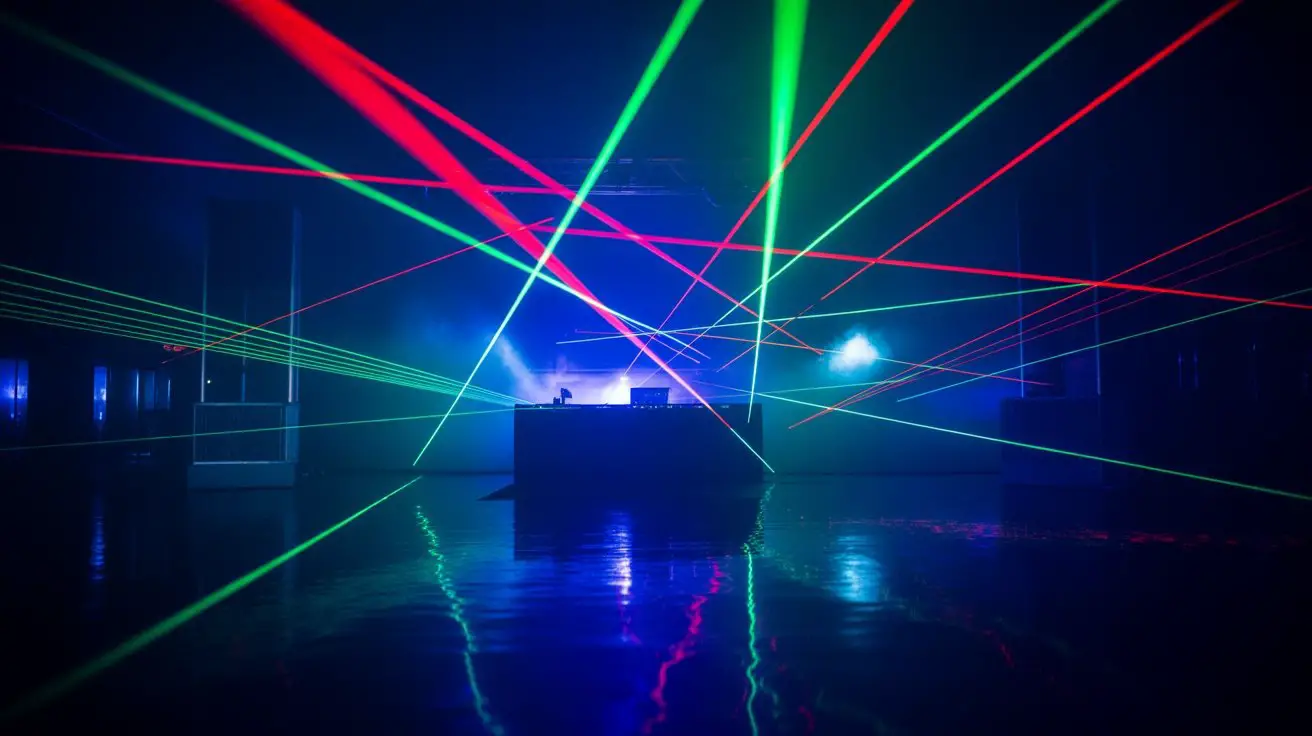
Your event’s unique requirements dictate which laser configuration will deliver maximum visual impact while staying within budget and venue constraints.
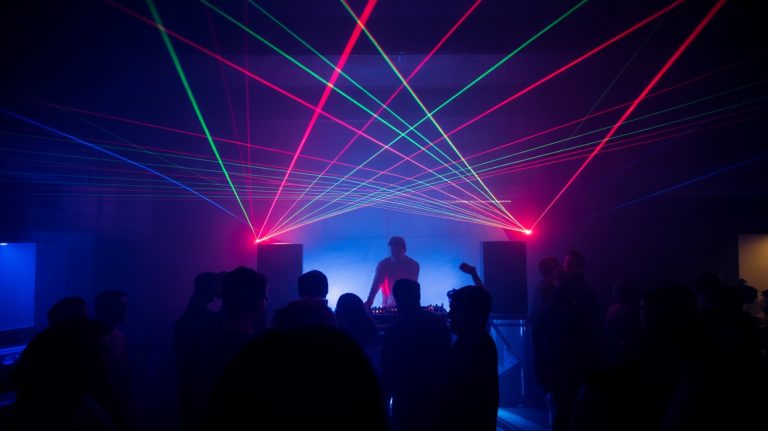
Consider venue size first—small rooms do fine with consumer party lasers (5mW or less), while large venues use 1-3W professional systems run under an FDA variance. Indoor events benefit from atmospheric haze machines that enhance beam visibility, whereas outdoor setups need weatherproof housings and higher power ratings.
RGB lasers offer full-spectrum color mixing for versatile displays, while single-color units provide focused intensity at lower costs. DMX-compatible fixtures integrate seamlessly with existing lighting controllers, enabling synchronized shows.
Factor in mounting requirements—truss systems, ground stands, or ceiling installations each present unique positioning advantages.
Safety classifications matter: in the US, using Class 3B or Class 4 lasers for a show requires an FDA variance, and aiming beams into the audience is only allowed when that variance covers it.
Installation and Positioning Best Practices
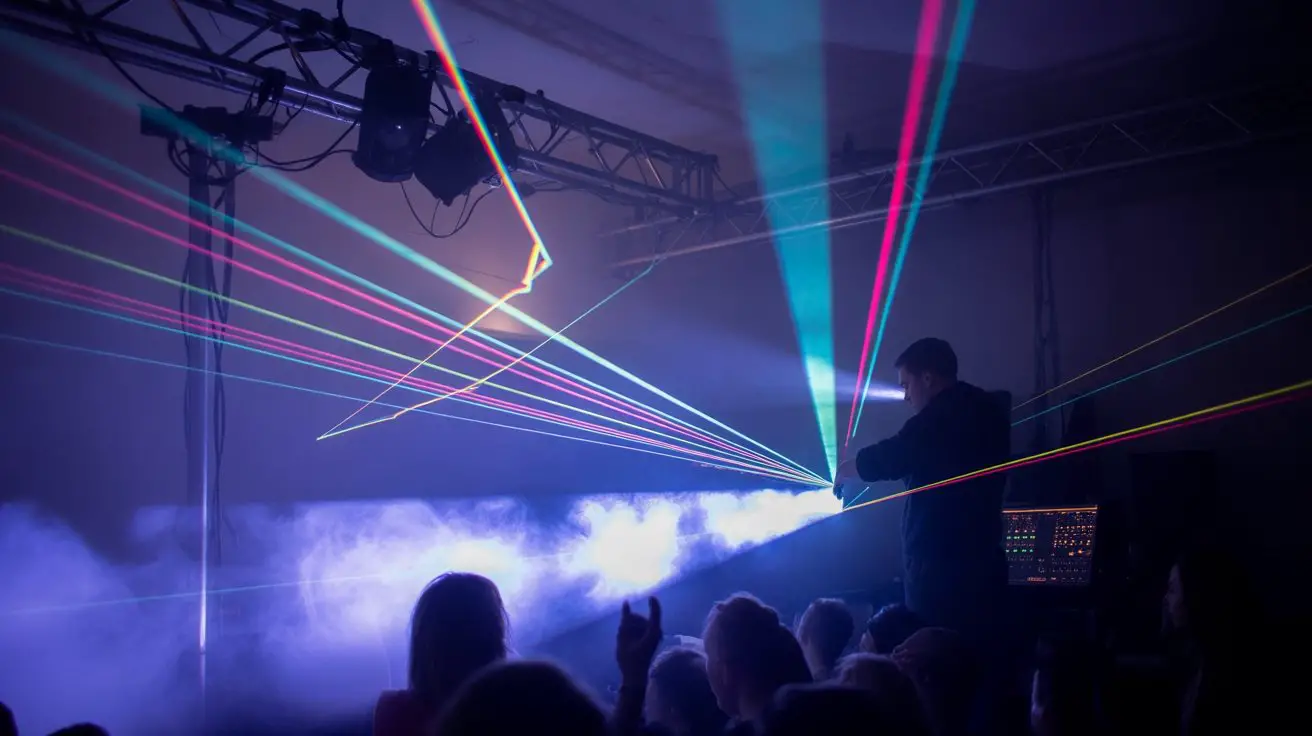
Whether you’re mounting fixtures on overhead truss systems or positioning ground-based units, proper laser placement transforms ordinary beam patterns into mesmerizing aerial displays that command audience attention.
Strategic positioning requires calculating beam trajectories, fog machine placement, and audience sightlines to maximize visual impact. Consider venue dimensions, ceiling height limitations, and safety zones when determining ideal mounting angles.
Essential Installation Guidelines:
- Mount lasers high and aim them so every beam stays at least 10 feet above the floor where people stand.
- Position fixtures at 45-degree angles to create dynamic intersecting patterns and depth perception.
- Space multiple units 8-10 feet apart to eliminate beam interference and guarantee coverage distribution.
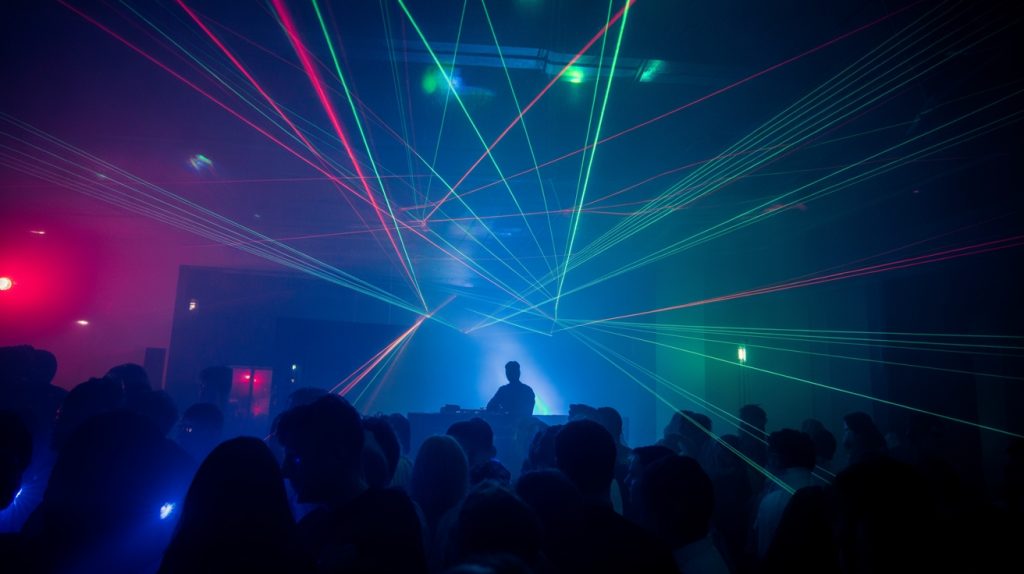
- Integrate atmospheric effects strategically by placing fog machines upstage to enhance beam definition without obscuring projections.
Proper cable management and secure mounting prevent equipment damage during high-energy performances.
Frequently Asked Questions
How Much Do Professional Laser Light Systems Typically Cost to Rent?
You’ll pay $200-500 daily for basic professional laser systems, while high-end RGB units with advanced DMX control cost $800-2000. Premium atmospheric laser arrays featuring beam shaping and wireless synchronization reach $3000+ per rental period.
Can Laser Lights Damage Phone Cameras or Professional Photography Equipment?
Like Icarus flying too close to the sun, your camera’s CCD/CMOS sensors can suffer permanent photodiode damage from direct laser exposure. You’ll need beam diffusion techniques and strategic positioning to protect your imaging equipment’s delicate photosensitive arrays.
How Long Do Laser Projectors Usually Last Before Needing Replacement?
You’ll typically get 20,000-30,000 hours from quality laser projectors before replacement’s necessary. Diode degradation, thermal cycling, and optical component wear determine longevity. Professional-grade units often exceed consumer models by several thousand operational hours through superior engineering.
Do Laser Lights Work Well in Outdoor Venues During Daylight Hours?
Daylight’s 100,000+ lux intensity overwhelms most laser projectors’ photon output, rendering them virtually invisible. Even very high-power units (10+ watts), which only licensed professionals should run, give a weak effect in outdoor daylight.
What Happens if Laser Equipment Breaks Down During an Event?
When your laser equipment malfunctions mid-event, you’ll need immediate backup units or alternative lighting solutions. Professional operators carry spare projectors, emergency power supplies, and contingency programming to guarantee seamless changes without compromising your show’s visual impact.
Conclusion
You’ve mastered the intricate photonics, calibrated the galvanometers, and synchronized every wavelength with surgical precision—all to create moments that exist only in fleeting memory. Your coherent light beams, traveling at 299,792,458 meters per second, illuminate faces for mere microseconds before disappearing forever. You’ve harnessed quantum mechanics and semiconductor engineering to craft something beautifully ephemeral. Isn’t it ironic? You’ve used humanity’s most advanced optical technology to create magic that can’t be captured.