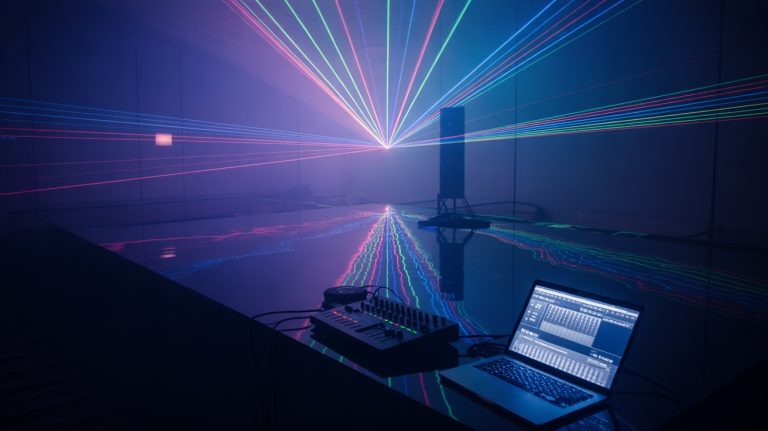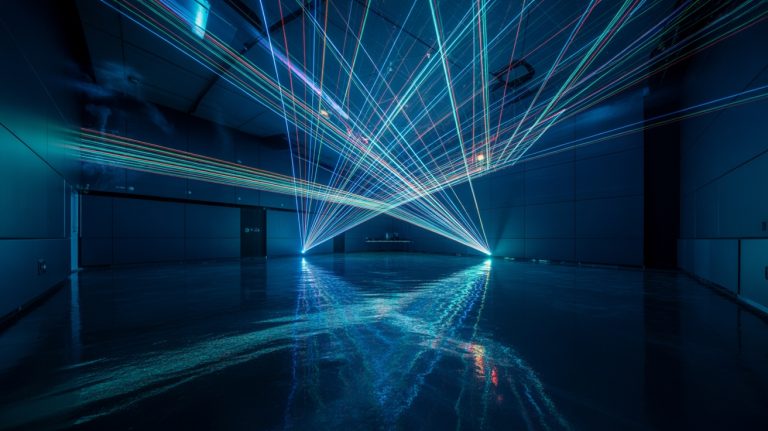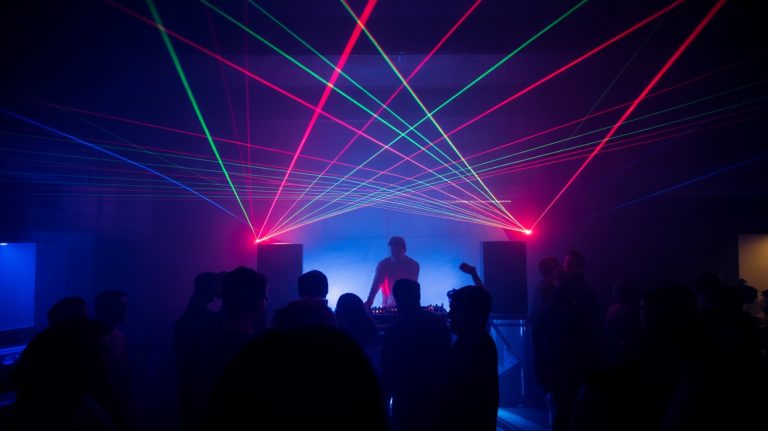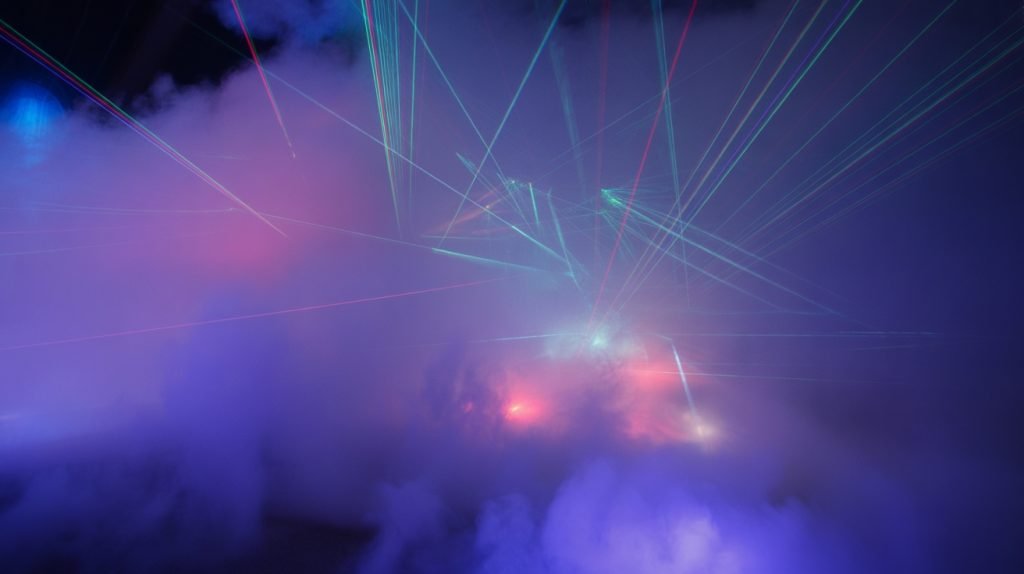
Like a symphony conductor orchestrating light and atmosphere, you’ll need to master the precise interplay between fog density and laser beam refraction to create truly spectacular visual displays. Your success depends on understanding particle suspension dynamics, optimizing fluid viscosity ratios, and maintaining proper ventilation CFM rates throughout your performance space. Without these fundamentals, you’re risking equipment damage, compromised beam visibility, and potentially hazardous atmospheric conditions that could shut down your entire production.
Understanding the Science Behind Fog and Laser Interaction
When laser beams encounter fog particles suspended in air, they undergo Mie scattering, which makes the otherwise invisible beam path visible to the human eye.
You’re fundamentally creating a three-dimensional canvas where photons interact with water droplets measuring 0.1 to 10 microns in diameter.
The scattering intensity depends mostly on particle density and size. Fog droplets scatter every visible laser color fairly evenly, which is why fog works with red, green, and blue beams alike.
You’ll achieve ideal visibility with a light, even haze rather than thick fog.
Consider beam divergence angles and power density calculations. Class 3B and Class 4 lasers require additional safety protocols in fog environments since beam visibility increases audience exposure risks. Hobby DJs should stick with consumer lasers of 5mW or less, since anything stronger needs an FDA variance before it can be used in a show.
Monitor ambient air circulation to maintain consistent particle distribution. Dense fog can create unwanted diffusion, reducing beam definition and potentially causing overheating in laser housing units. Utilizing fog effectively can enhance the overall visual impact of your laser show, creating a mesmerizing experience for the audience.
Choosing the Right Fog Machine for Your Laser Setup
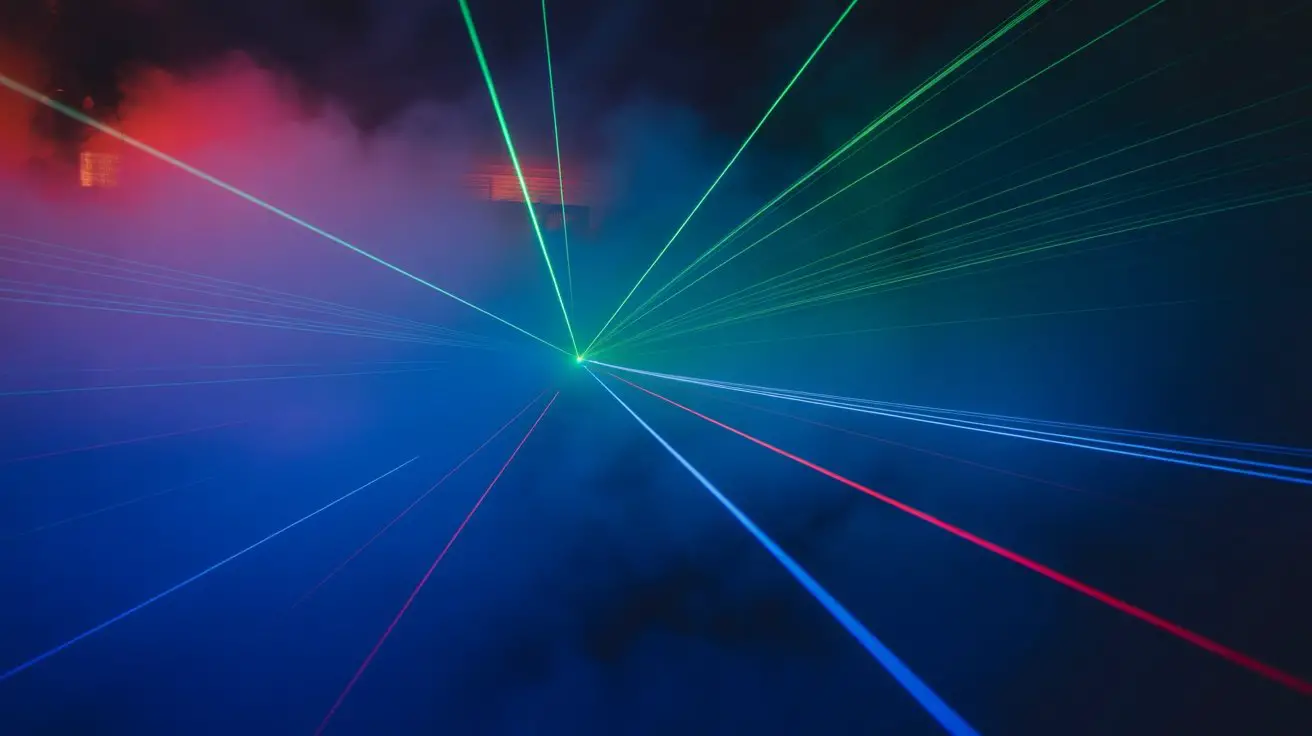
Three primary fog machine types dominate the laser entertainment industry: water-based hazers, oil-based hazers, and dry ice machines.
You’ll need water-based hazers for consistent, long-lasting atmospheric effects with minimal residue. They’re ideal for venues requiring clean operations and extended run times.
Oil-based hazers produce denser fog with superior laser beam definition but require more ventilation due to oily residue accumulation. They’re preferred for high-impact shows where maximum visual density is critical.
Dry ice machines create low-lying fog that won’t interfere with upper-level laser projections. However, you must guarantee adequate CO2 ventilation and handle dry ice with proper safety protocols. Fog machines are considered safer than smoke machines due to their non-toxic components.
Consider your venue’s ventilation capacity, power requirements, fluid consumption rates, and local fire safety regulations when selecting equipment.
Match output volume to room size for best beam visibility.
Selecting Compatible Fog Fluids and Atmospheric Effects
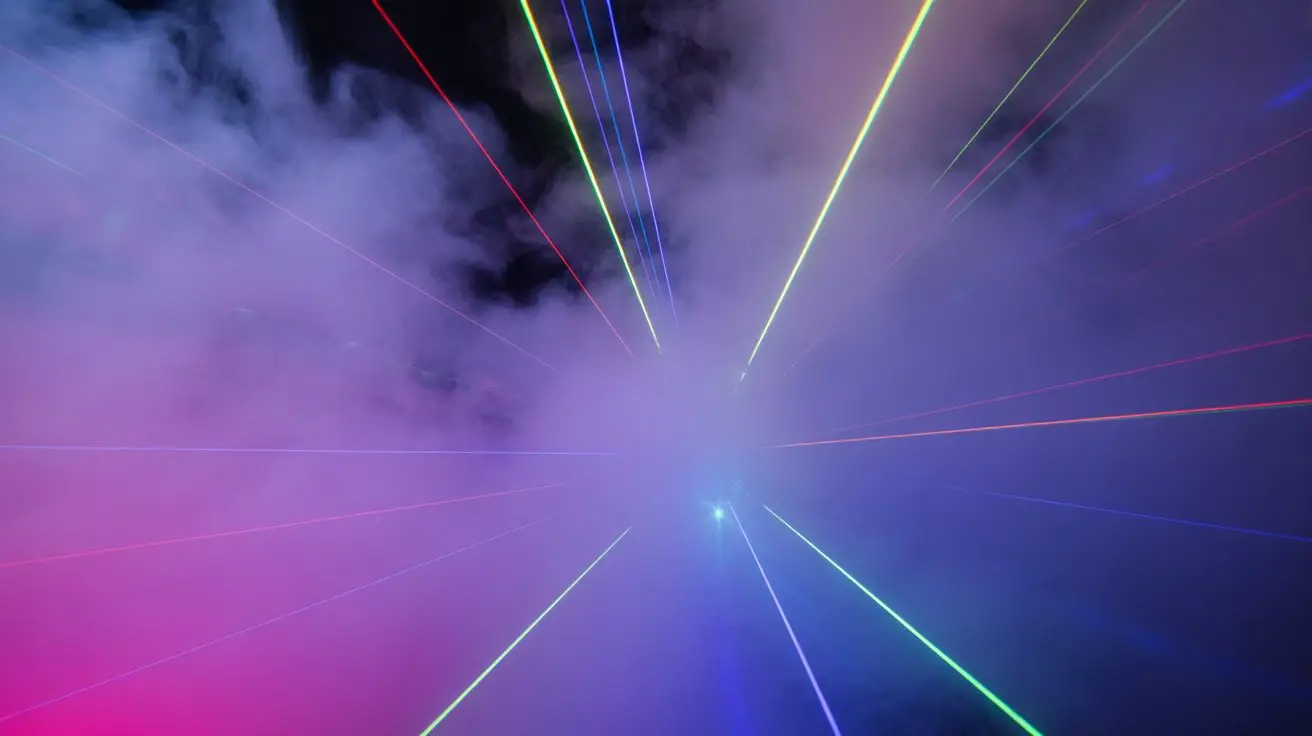
Your fog machine’s performance depends heavily on selecting the proper fluid formulation, as incompatible fluids can damage equipment, create safety hazards, or produce subpar atmospheric effects.
Water-based fog fluids offer the safest option for laser applications, producing dense, long-hanging fog that enhances beam visibility without residue buildup. Oil-based fluids create finer particles but can leave deposits on laser optics and surfaces.
Essential fluid selection criteria include:
- Glycol concentration – Higher percentages produce denser fog with longer hang time
- Viscosity rating – Must match your machine’s pump specifications
- Particle size – Ideal 0.2-0.5 microns for maximum laser scattering
- Dissipation rate – Consider venue ventilation and show duration requirements
- Safety certifications – Verify non-toxic, theater-safe formulations for occupied spaces
Always verify fluid compatibility with manufacturer specifications before use. Additionally, understanding the common liquid components used in fog machines can help you make an informed decision when selecting your fog fluid.
Strategic Equipment Positioning and Room Layout
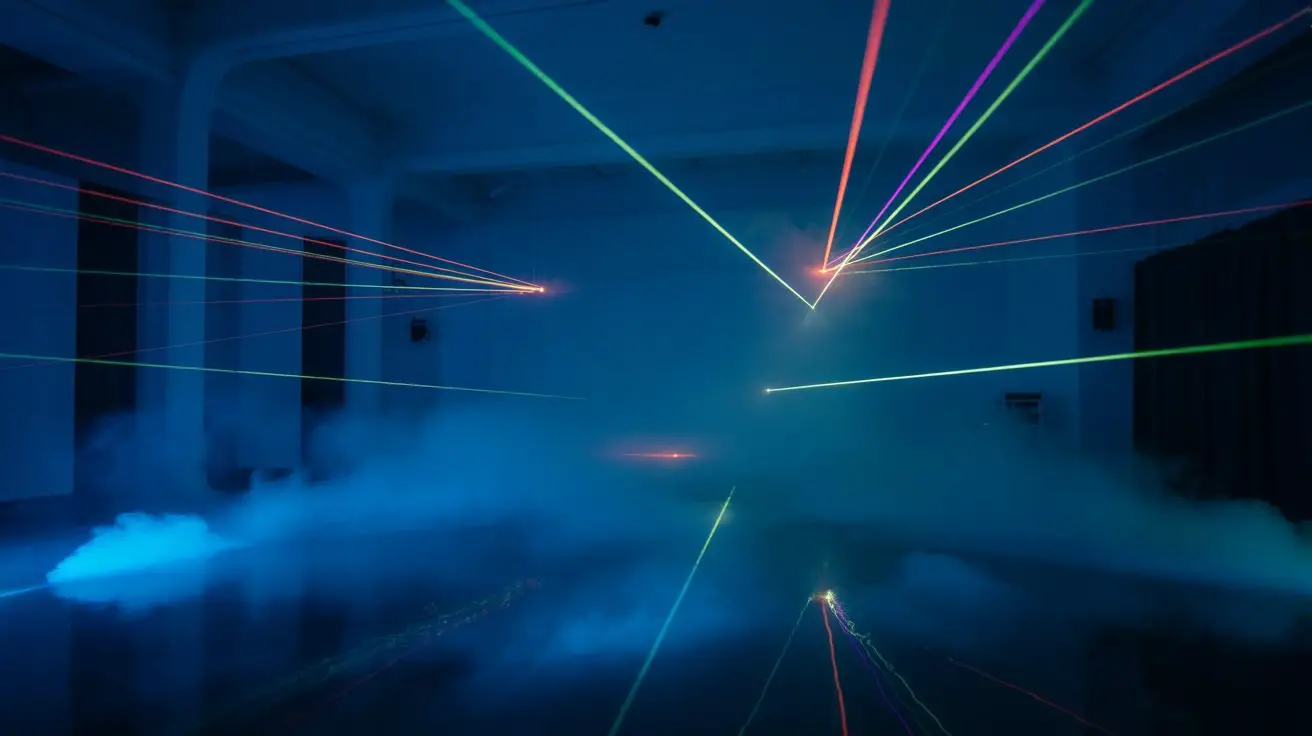
Proper equipment placement determines whether your fog and laser combination creates stunning atmospheric effects or disappointing visual gaps with potential safety risks.
Position fog machines at strategic low points where fluid density naturally accumulates while maintaining clear egress paths. Install laser projectors at elevated positions to maximize beam penetration through suspended particulate matter. Consider HVAC airflow patterns when determining equipment coordinates—cross-ventilation will rapidly dissipate atmospheric effects. Additionally, ensure that you use fog juice compatible with your fog machine to achieve the desired visual clarity and density.
| Equipment Type | Ideal Height | Distance from Audience | Safety Clearance |
|---|---|---|---|
| Fog Machines | Floor level | 8-12 feet minimum | 3 feet radius |
| Laser Projectors | 10+ feet elevation | Variable beam path | No direct exposure |
| Haze Generators | Mid-level mount | 15-20 feet | 5 feet clearance |
| Control Systems | Accessible height | Operator sightlines | Protected location |
Establish redundant equipment positioning to eliminate dead zones where laser visibility drops considerably.
Timing and Synchronization Techniques
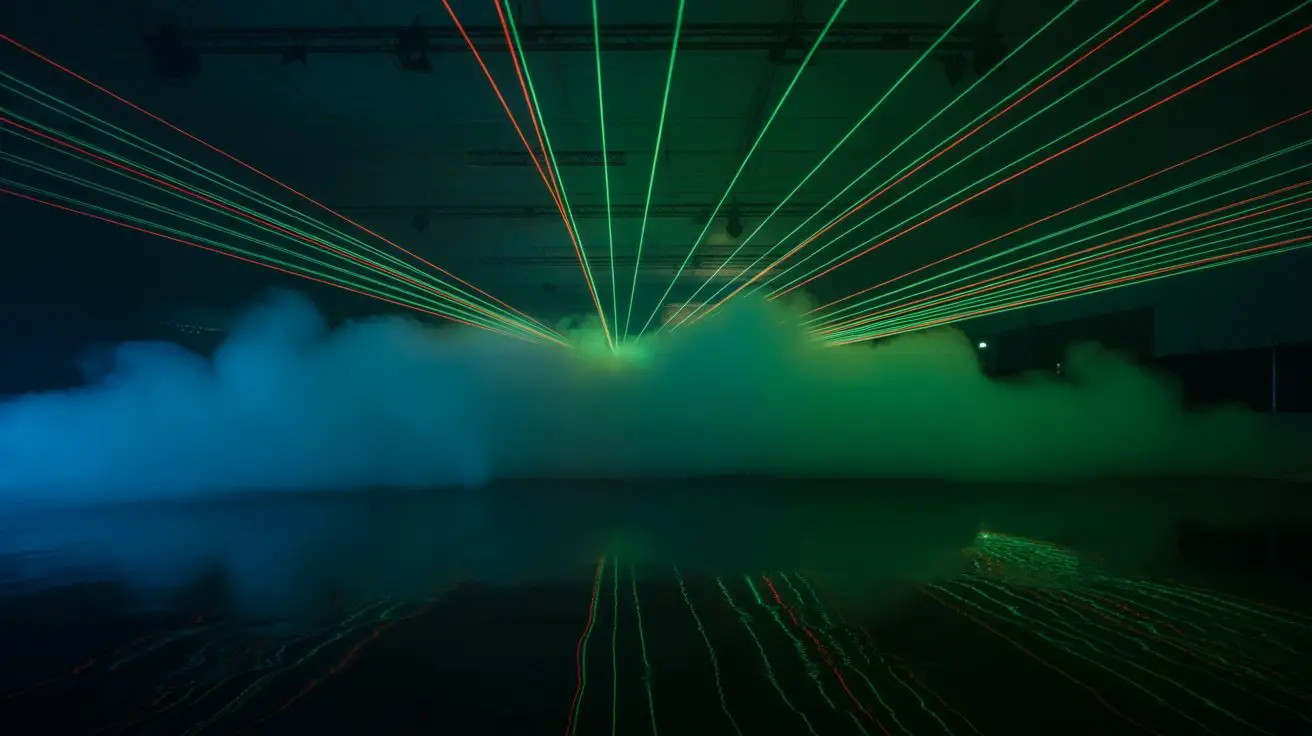
When atmospheric effects and laser beams operate in perfect synchronization, you’ll achieve maximum visual impact while maintaining precise control over audience safety zones. Master these coordination methods to execute flawless performances.
DMX protocol serves as your primary synchronization backbone, enabling precise timing control between fog output and laser sequences. Program your controller to trigger fog bursts 3-5 seconds before laser activation, allowing ideal particle density development.
Essential synchronization techniques include:
- Pre-cueing fog output – Deploy atmospheric effects before laser sequences begin
- DMX channel mapping – Assign dedicated control channels for each device type
- Timing offset calibration – Account for fog dispersion delays in your programming
- Safety interlock integration – Link emergency stops across all systems
- Real-time monitoring – Track atmospheric density for consistent beam visibility
It’s also important to consider that fog machines generally do not set off sprinkler systems due to their low heat output.
Test all timing sequences during technical rehearsals under actual performance conditions.
Safety Considerations and Ventilation Requirements
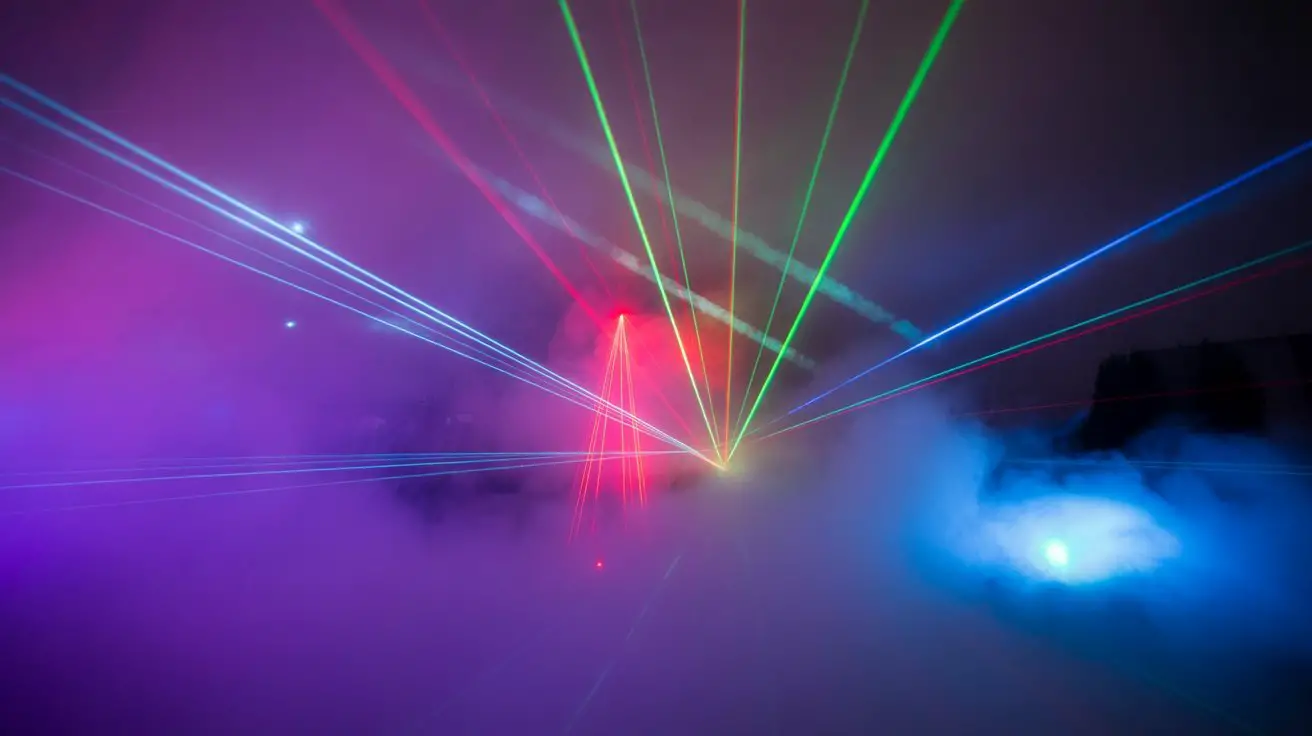
Professional laser and fog operations demand rigorous safety protocols that protect both performers and audiences from potential hazards.
You’ll need adequate ventilation systems to prevent fog accumulation that can obscure emergency exits and create respiratory discomfort. Install exhaust fans with minimum 6 air changes per hour, positioning intake vents at floor level and exhaust points near ceiling height.
Maintain clear sightlines to all exit routes throughout your performance. Never exceed manufacturer-recommended fog fluid output rates, as dense atmospheric conditions can set off smoke detectors.
You must comply with local fire codes regarding haze density limits and venue occupancy restrictions.
Monitor air quality continuously using particulate meters. Guarantee laser operators maintain visual contact with beam paths, as fog can scatter light unpredictably, potentially creating audience exposure above MPE thresholds.
Troubleshooting Common Performance Issues
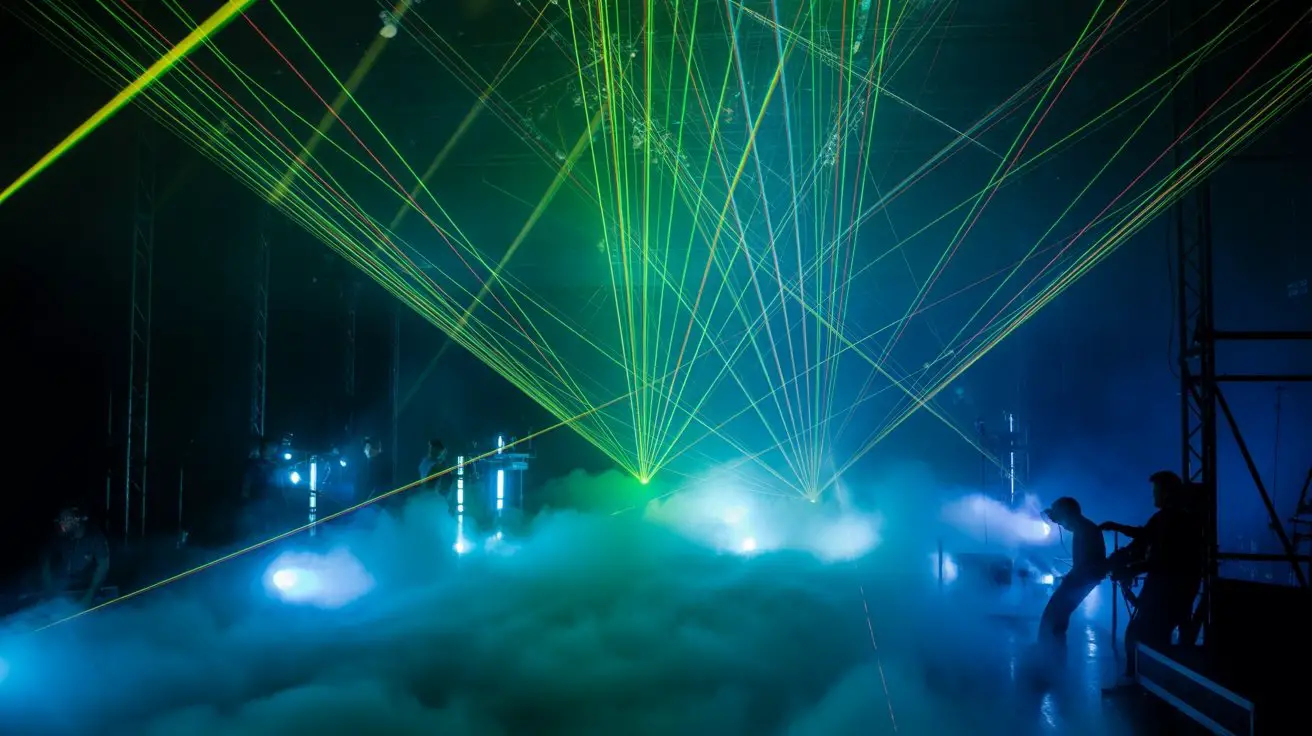
Even with meticulous preparation, you’ll encounter operational challenges that can compromise your fog-laser integration during live performances.
Uneven fog distribution creates dead zones where laser beams become invisible, while excessive fog density can completely obscure your light show. Temperature fluctuations affect fog consistency and dissipation rates, particularly problematic in outdoor venues or poorly climate-controlled spaces.
Common troubleshooting scenarios include:
- Fog machine clogging – Flush with distilled water between uses
- Inconsistent beam visibility – Adjust fog output timing with laser cues
- Hazer malfunction – Check fluid levels and heating element functionality
- Poor fog hang time – Verify atmospheric conditions and ventilation settings
- Laser scatter interference – Reduce fog density near projection sources
Monitor fluid consumption rates and maintain backup equipment for critical performances.
Frequently Asked Questions
What Is the Typical Cost Range for a Basic Fog and Laser Setup?
You’ll spend $200-800 for entry-level equipment: $50-200 for basic fog machines, $150-600 for Class IIIa lasers. Don’t compromise on safety features—invest in proper ventilation, laser safety glasses, and FDA-compliant units meeting CDRH regulations.
Can I Rent Fog Machines and Laser Equipment Instead of Purchasing Them?
You can rent fog machines and laser projectors from theatrical equipment suppliers or event production companies. Verify operator certifications, safety compliance, and equipment specifications match your venue requirements before finalizing rental agreements.
Do I Need Special Permits or Licenses to Operate Laser Shows Publicly?
You’ll need FDA variance permits for Class IIIb/IV lasers in public venues. Contact your local fire marshal for fog machine regulations. ILDA certification’s recommended for operators. Check municipal noise ordinances and venue-specific safety requirements before your event.
How Long Does Fog Fluid Typically Last During a Standard Event?
Time flies when you’re creating atmosphere! Your fog fluid consumption depends on machine output rate, venue size, and ambient airflow. Standard 1-liter bottles typically provide 8-12 hours of intermittent operation at medium density settings.
What Insurance Considerations Should I Have for Fog and Laser Events?
You’ll need extensive liability coverage for audience injury claims, equipment damage protection, and venue-specific policies. Verify your insurer covers laser classification levels and atmospheric effects. Document all safety protocols and operator certifications to validate coverage.
Conclusion
You’ve now mastered the art of orchestrating fog and laser symphonies that’ll transform your venue into a mesmerizing visual cathedral. By implementing proper fluid selection, strategic positioning, and precise timing protocols, you’ll achieve those razor-sharp beam definitions that cut through the atmospheric haze like lightning through storm clouds. Remember, safety remains your North Star—maintain adequate ventilation, monitor particulate density levels, and always conduct pre-show equipment diagnostics to guarantee flawless performance execution every time.