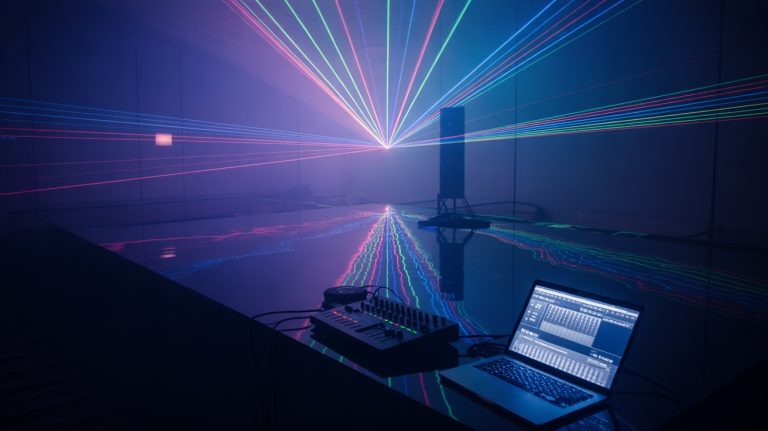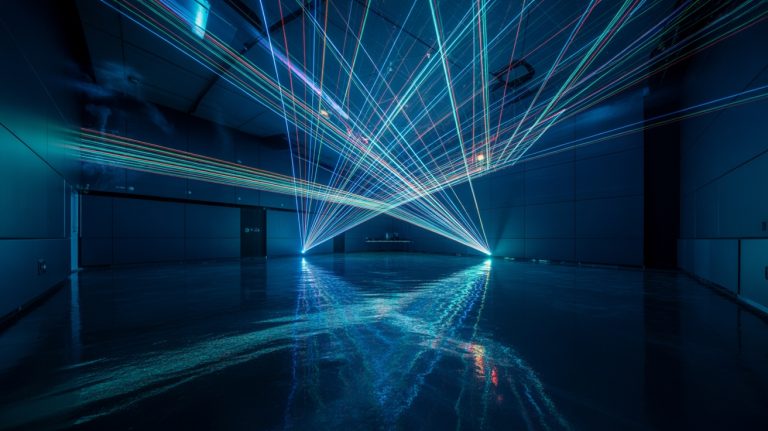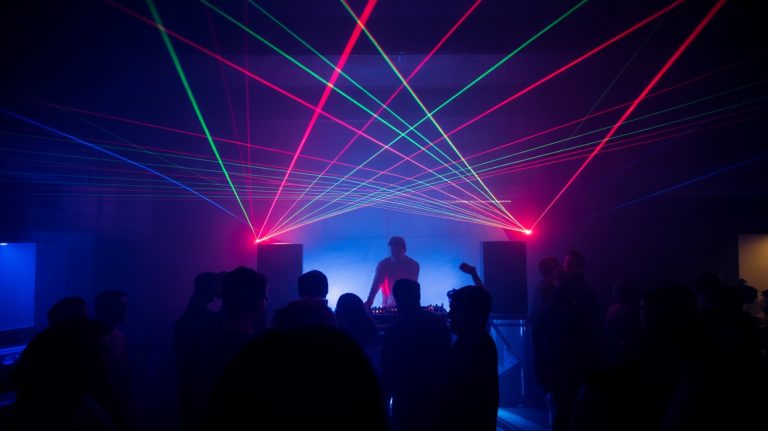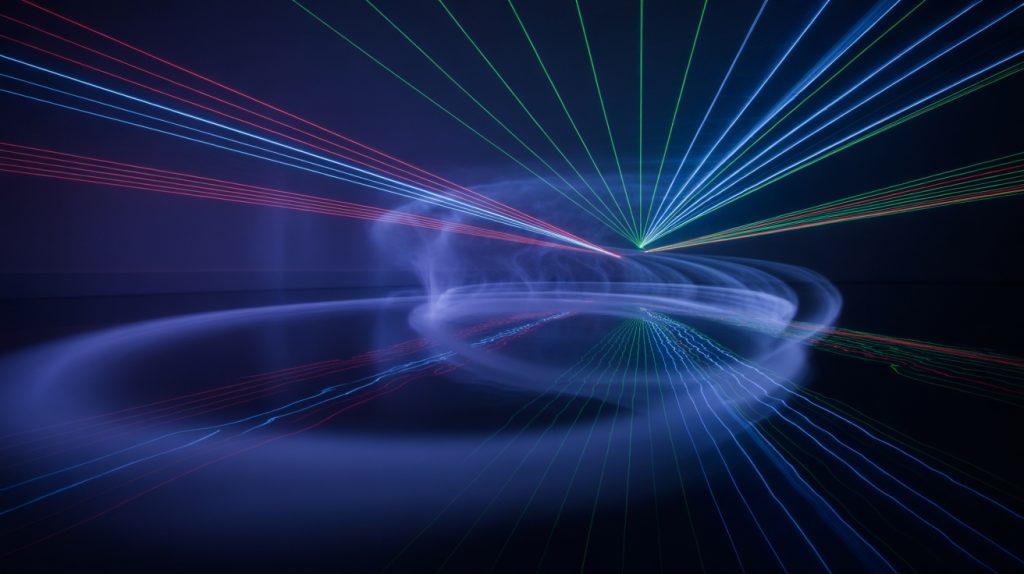
You’ve likely witnessed the mesmerizing spectacle of laser beams cutting through atmospheric haze, creating visible light paths that seem to dance in mid-air. This isn’t magic—it’s physics in action, where suspended fog particles act as tiny reflectors, revealing the laser’s invisible journey through space. However, achieving this effect safely and effectively requires precise coordination between your fog machine’s particle output and laser specifications. The wrong combination can result in disappointing visibility or dangerous exposure levels that’ll compromise both your show and audience safety.
Understanding the Science Behind Fog and Laser Interaction
When laser light encounters fog particles, it creates a visible beam through a phenomenon called Mie scattering.
You’ll see this effect because microscopic water droplets in artificial fog act as tiny mirrors, reflecting and dispersing laser photons in all directions. The smaller the particles, the more intense your beam visibility becomes.
Different fog fluids produce varying particle sizes, directly affecting beam clarity. Water-based fluids create finer droplets than oil-based alternatives, resulting in sharper beam definition.
You must maintain proper fog density—too little won’t illuminate beams effectively, while excessive fog can obscure them entirely.
Temperature and humidity influence particle behavior. Cooler environments maintain fog longer, while warm air causes rapid dissipation. Additionally, be aware that fog machines can trigger fire alarms due to their smoke particle emissions, which may lead to unintended disruptions during your show.
Always guarantee adequate ventilation when combining these effects, as concentrated fog can reduce visibility and create safety hazards in performance spaces.
Selecting Compatible Fog Machine and Laser Equipment
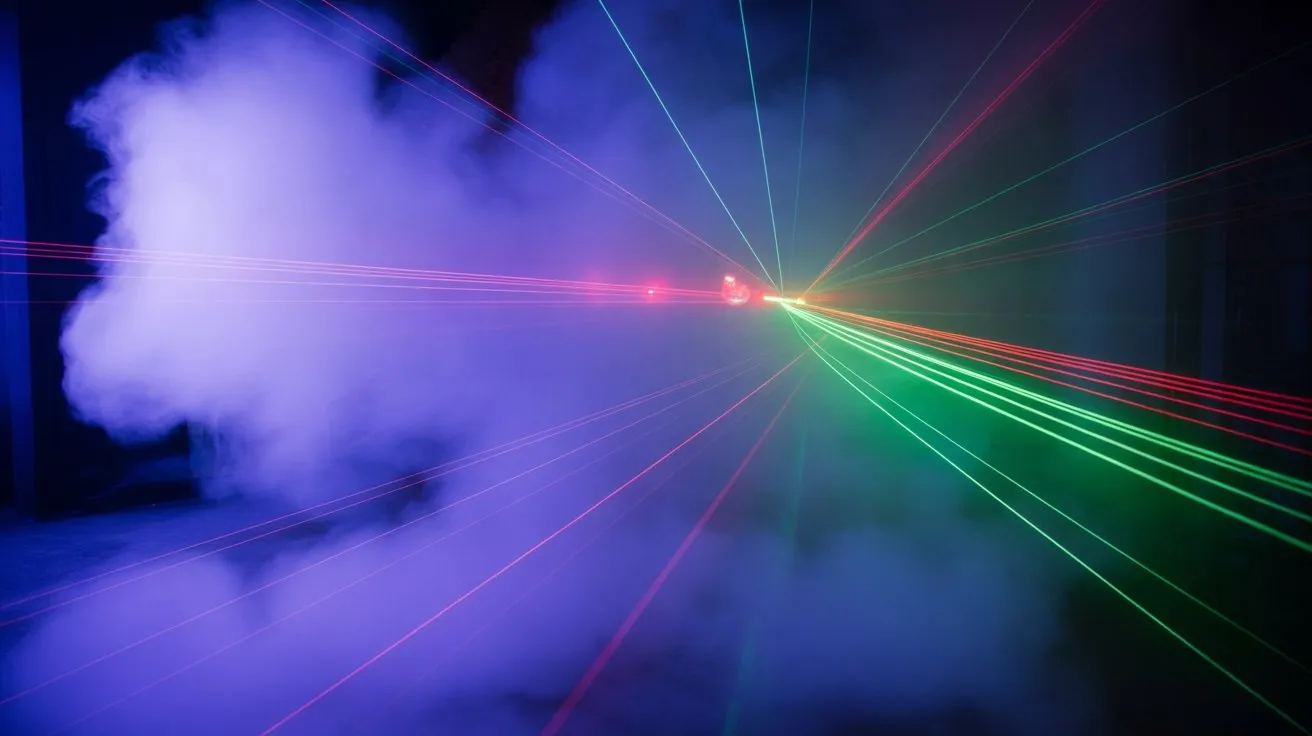
Building on the particle interaction principles, your equipment selection determines beam visibility quality and operational safety.
You’ll need fog machines producing 0.5-3 micron particles for ideal laser diffusion. Water-based fog fluid creates the cleanest particle suspension without residue buildup on laser optics.
For a home party or hobby DJ gig, use a consumer laser of 5mW or less. Class 3B and 4 show lasers need an FDA variance and a trained operator in the US, so leave them to licensed laser show companies.
Choose fog machines with adjustable output controls—DMX-512 compatibility guarantees synchronized timing with laser sequences.
Consider hazer units for sustained atmospheric effects versus burst fog machines for dramatic reveals.
Your venue size dictates fog volume calculations: 1000 cubic feet requires 400-watt minimum fog output.
Install fog machines at floor level while positioning lasers elevated for maximum beam intersection through the fog layer. Additionally, opt for machines with higher wattage to enhance fog output intensity and coverage area.
Safety Protocols and Legal Requirements
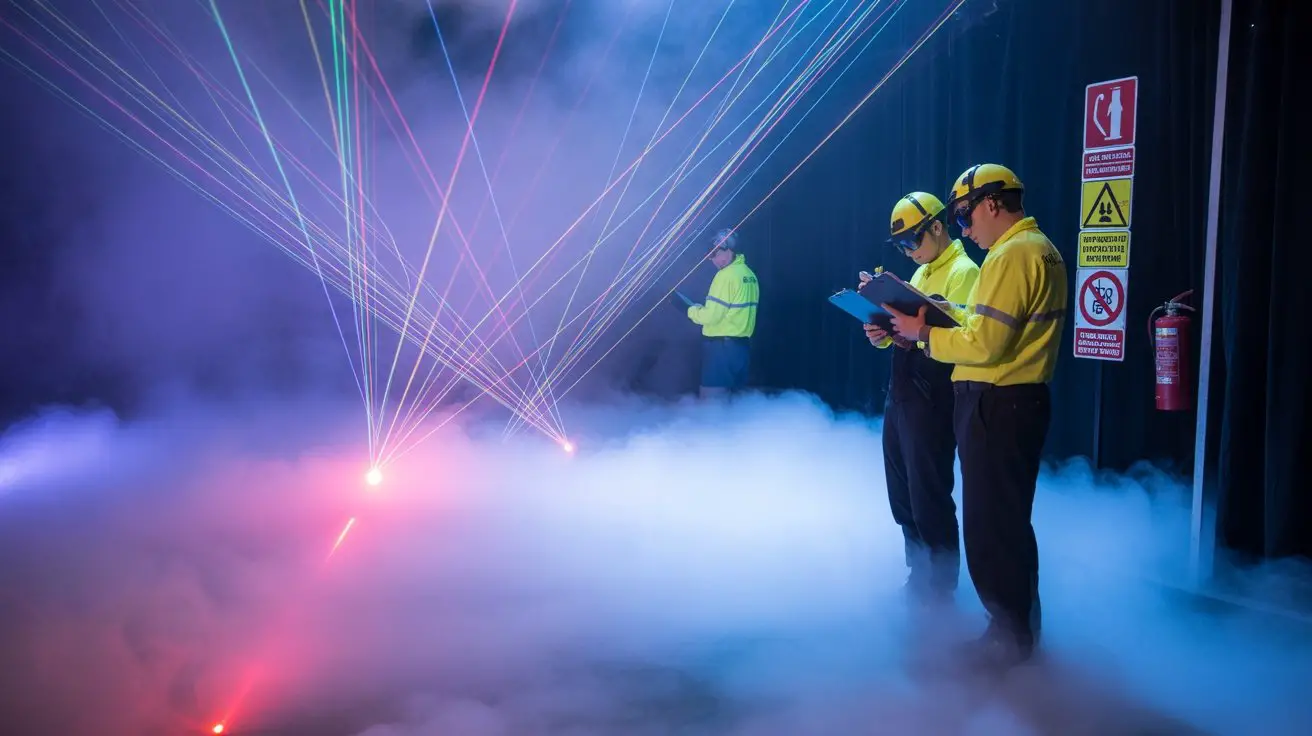
Before operating combined fog and laser systems, you must understand that laser safety regulations vary considerably between jurisdictions and venue types.
Professional installations require compliance with FDA, OSHA, and local fire marshal guidelines.
Your safety checklist includes:
- Audience scanning limits – Never direct Class 3B or 4 lasers toward occupied areas without proper variance permits
- Fog fluid composition – Use water-based, non-toxic formulations approved for indoor air quality standards
- Emergency protocols – Install laser interlock systems and maintain clear evacuation routes unobstructed by fog density
- Operator certification – Guarantee laser safety officer training for Class 3B+ systems in commercial environments
You’ll need written approval from venue management and insurance verification.
Document all safety measures, maintain equipment logs, and conduct pre-show safety briefings with staff handling the combined systems. Additionally, be aware that fog machine health hazards can affect both operators and audience members, especially those with respiratory conditions.
Optimal Fog Density and Particle Size for Laser Visibility
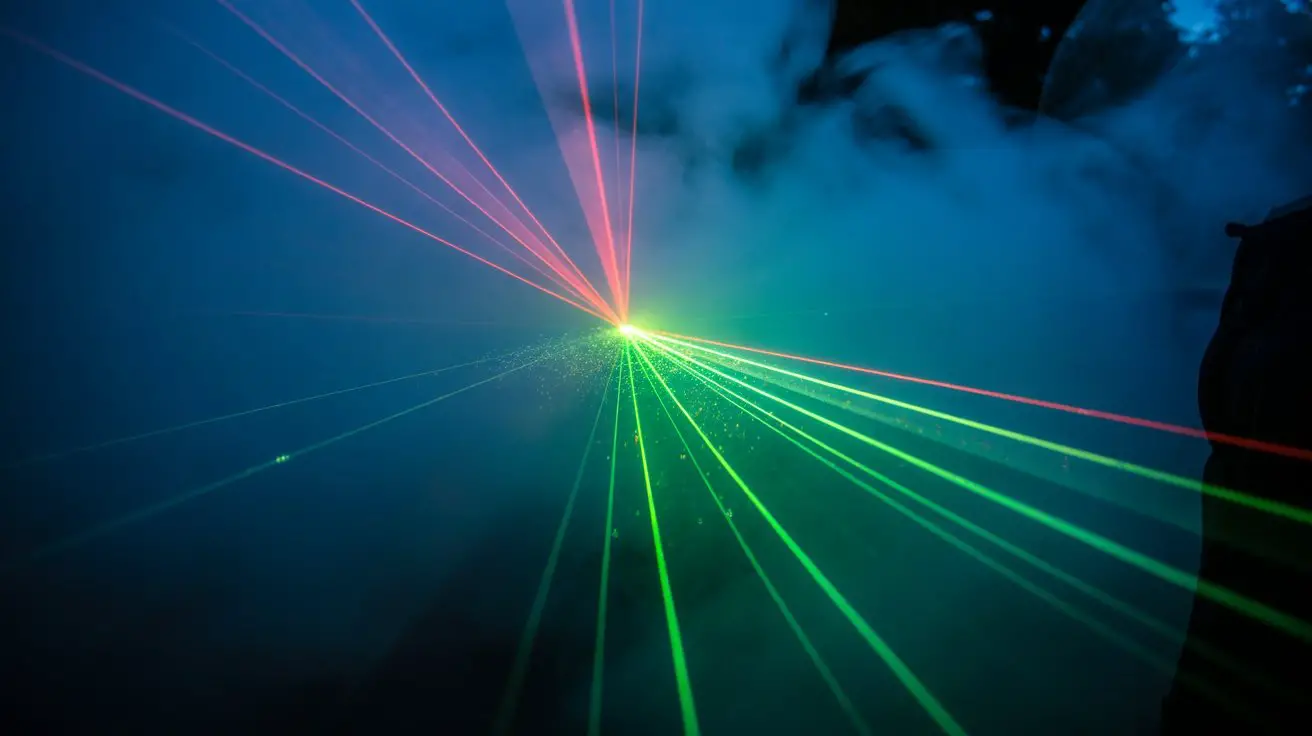
Since laser beam visibility depends entirely on light scattering through suspended particles, you’ll need to achieve the precise fog density that maximizes beam definition without creating visual obstruction.
Target particle sizes between 0.3-1.0 microns for ideal scattering efficiency with visible laser wavelengths.
Monitor fog density using a simple visibility test: you should clearly see objects 10-15 feet away while maintaining crisp laser beam definition.
Too dense, and you’ll create a wall of white haze that obscures beams. Too thin, and beams become barely visible or completely disappear.
Water-based fog produces smaller, more uniform particles than oil-based alternatives, delivering consistent scattering patterns. Additionally, using fog machines with adjustable output rates can help you achieve the perfect atmosphere for your laser displays.
Adjust your fog machine’s output rate gradually, allowing 30 seconds between adjustments for proper atmospheric distribution before making intensity corrections.
Timing and Synchronization Techniques
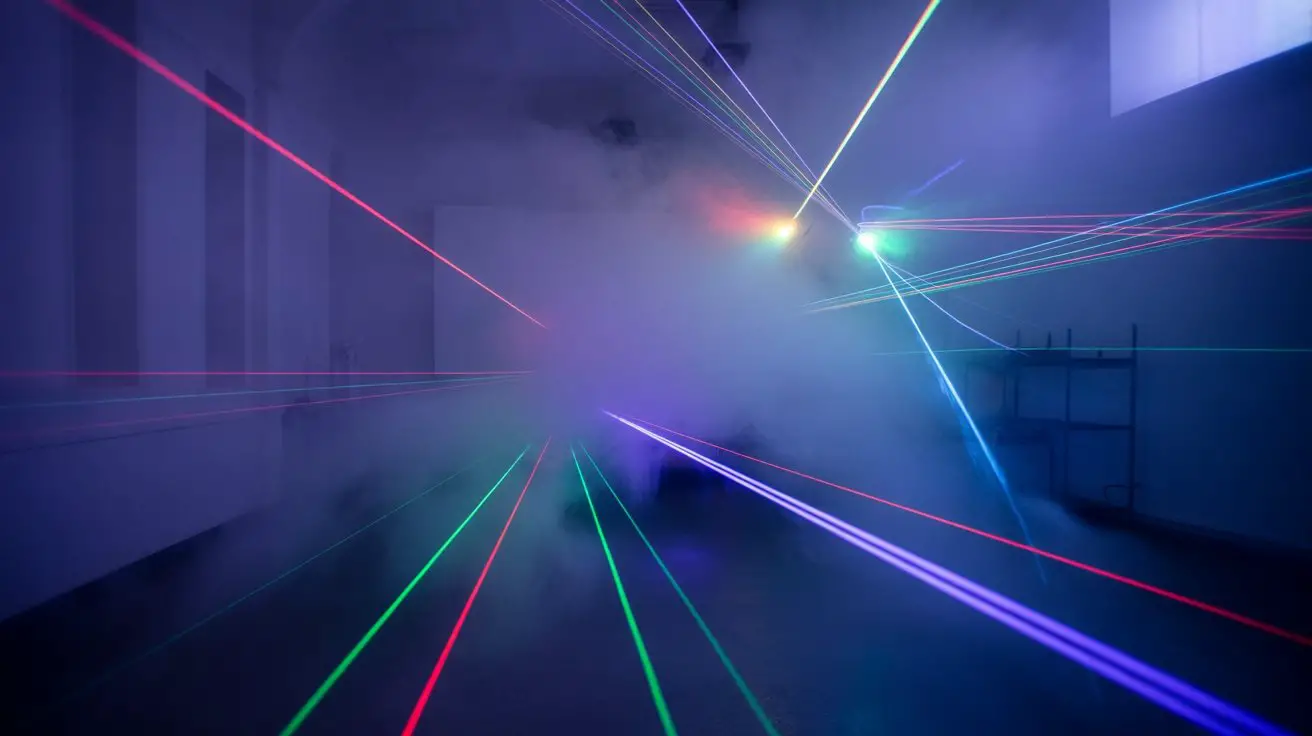
Perfect fog density means nothing without proper timing between your laser activation and fog output.
You’ll need to coordinate these elements precisely to create stunning visual effects while maintaining safety protocols.
- Pre-fog timing: Activate fog machines 30-45 seconds before laser engagement to establish proper atmospheric density.
- Sequential layering: Trigger short fog bursts followed by laser pulses to create dramatic reveal effects and prevent oversaturation.
- DMX synchronization: Use DMX controllers to program exact timing sequences between fog output and laser patterns for consistent results.
- Temperature monitoring: Allow fog machines 2-3 minute cool-down periods between intensive sequences to prevent overheating.
Monitor your venue’s ventilation system continuously.
Poor timing creates visibility hazards and reduces beam definition, compromising both safety and visual impact. Additionally, ensure that the fog machine’s fluid tank and output capacity are suitable for your event size to achieve the desired effects.
Positioning and Angle Considerations for Maximum Effect
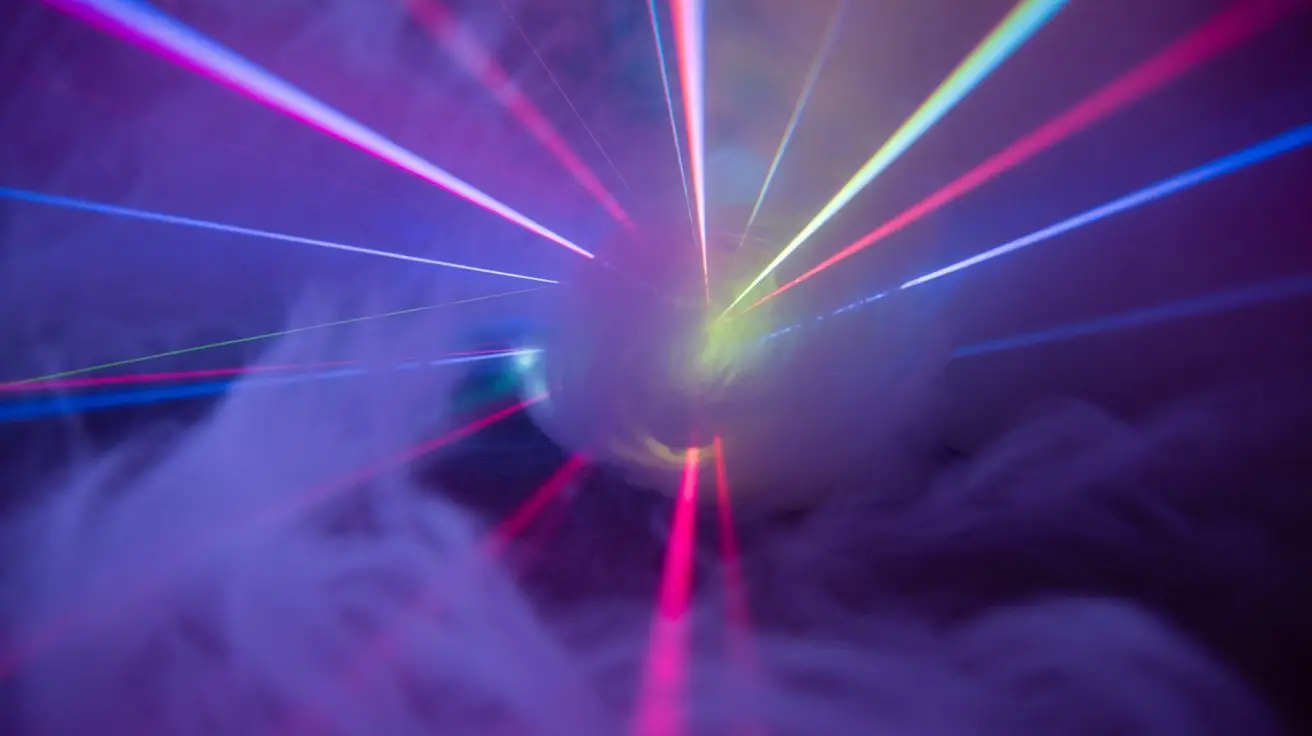
Strategic placement of your fog machines and laser units determines whether you’ll achieve razor-sharp beam definition or wasted atmospheric effects.
Position fog machines at ground level, creating upward drift that intersects laser beams at ideal heights. Mount lasers high enough that every beam stays at least 10 feet above the floor wherever people stand.
Angle lasers so the beams slice through the fog above head height, never down into the crowd. Cross-beam positioning creates dimensional depth—place units at opposite corners for intersecting patterns.
Avoid placing fog machines directly below lasers, which creates oversaturation and beam washout.
Consider audience sightlines when positioning equipment. Keep every laser beam above head height to prevent direct eye exposure, while fog machines positioned behind crowds push atmosphere forward.
Test fog density at various distances—typically 6-15 feet from machines provides ideal beam visibility without overwhelming opacity.
Venue Ventilation and Environmental Factors
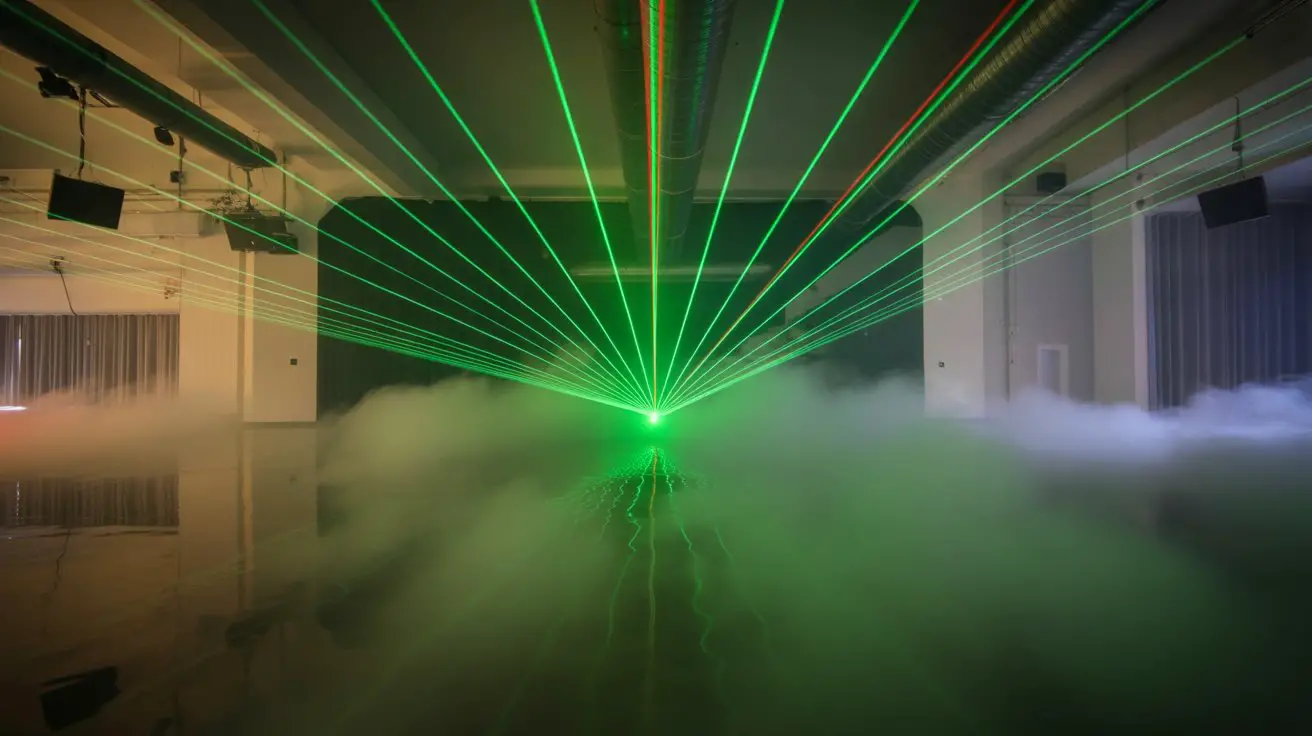
Room airflow patterns directly impact how fog disperses and laser beams maintain their visual integrity throughout your event.
You’ll need to assess your venue’s HVAC system, natural air currents, and ceiling height to control fog distribution effectively.
Strong ventilation systems can pull fog away from laser paths, creating inconsistent effects.
Map airflow directions before setup to position equipment strategically.
Consider these environmental factors:
- Temperature differentials – Warm air rises, carrying fog upward and away from ground-level laser projections
- Humidity levels – High humidity extends fog hang time but may cause equipment condensation issues
- Air circulation patterns – Identify dead zones where fog naturally accumulates versus high-flow areas that disperse quickly
- Ceiling height – Low ceilings trap fog longer, while high ceilings require more output for visible density
Programming and Control Systems
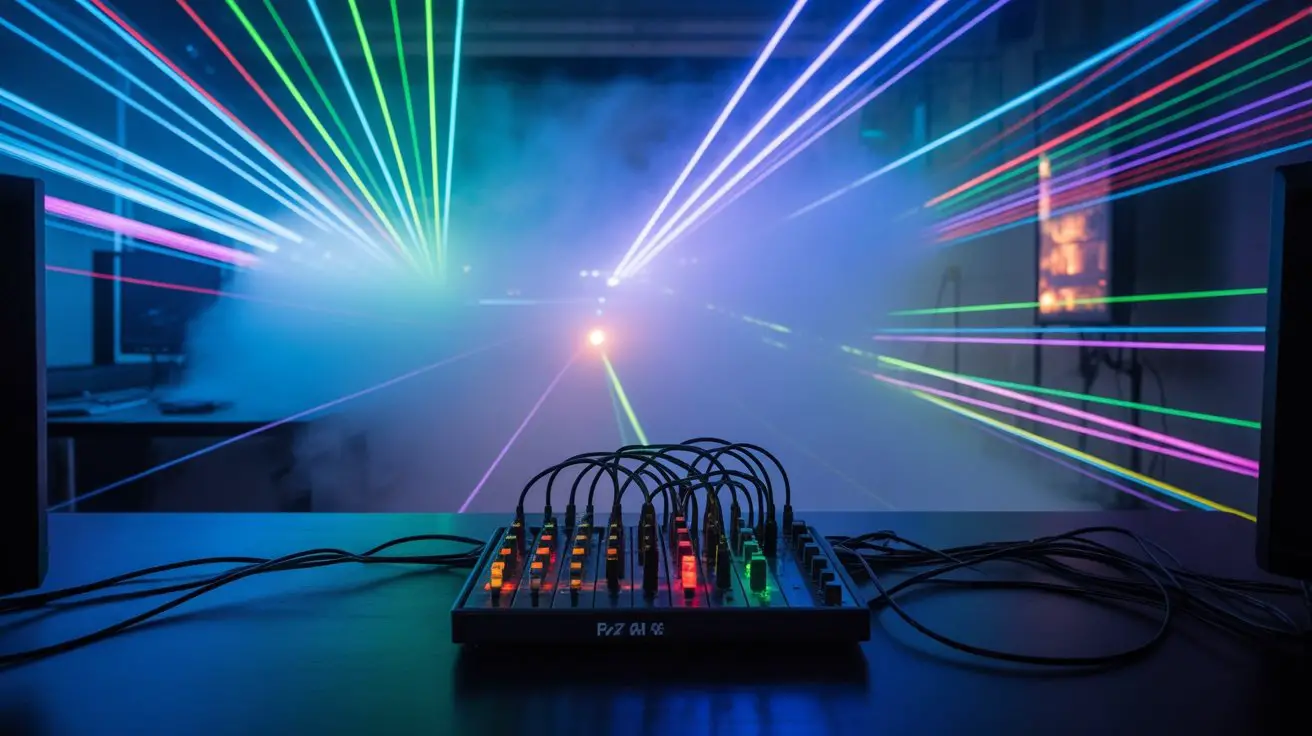
When you’re coordinating multiple fog machines and laser systems, centralized control becomes essential for achieving synchronized effects that respond to your event’s rhythm.
DMX512 protocol provides the industry standard for linking equipment through daisy-chained connections. You’ll program scenes using lighting consoles or software like QLC+ or LightJockey, mapping each device to specific channels. Set fog machines to burst before laser activation—this creates ideal particle density for beam visibility.
Configure MIDI triggers to synchronize with your audio tracks, ensuring effects hit musical peaks. Install emergency stop switches within operator reach for immediate shutdown. Use isolated power circuits to prevent voltage drops that disrupt timing.
Test all cue sequences during rehearsals, verifying fog dissipation rates match your programmed laser sequences for consistent visual impact throughout your performance.
Troubleshooting Common Performance Issues
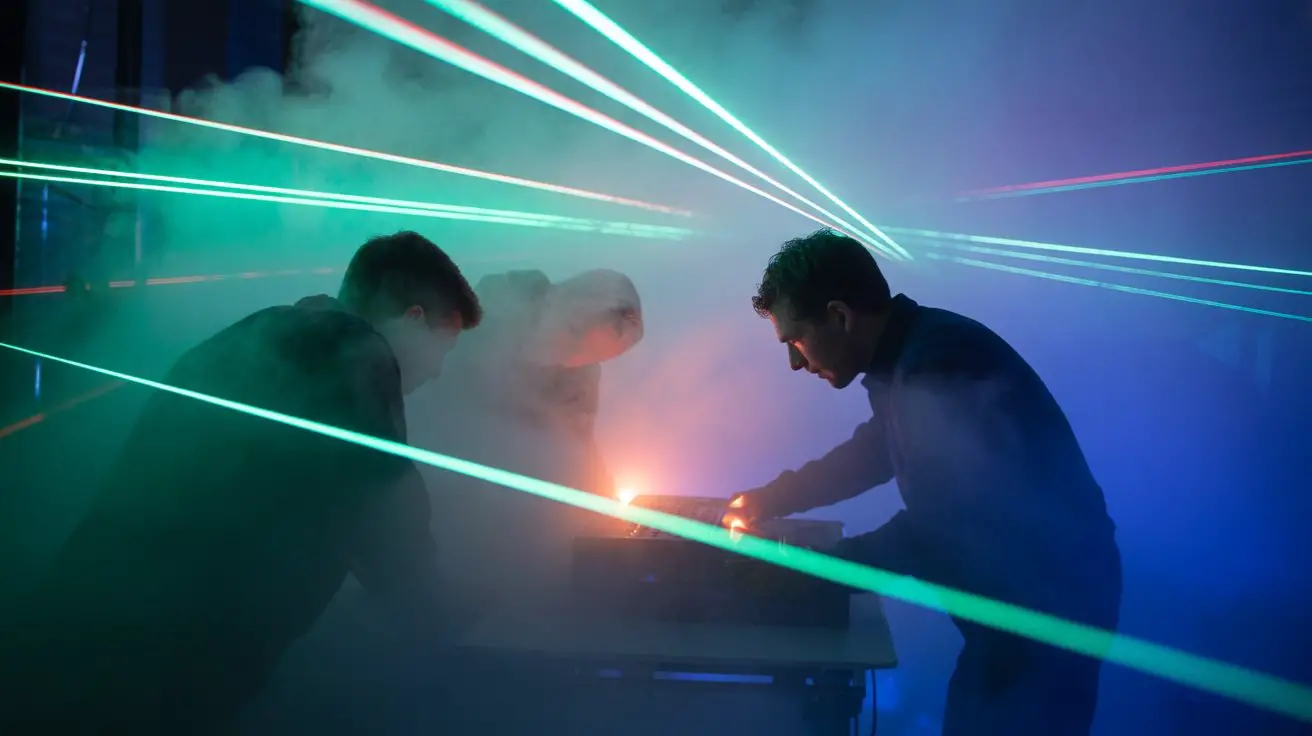
Even perfectly programmed fog and laser systems can develop issues during live performances that demand quick identification and resolution.
You’ll need to diagnose problems rapidly while maintaining safety protocols and show continuity.
Common performance disruptions require systematic troubleshooting approaches:
- Fog density irregularities – Check fluid levels, heating element temperature, and ventilation interference that’s diluting your fog output.
- Laser beam visibility loss – Verify fog machine positioning relative to laser projection paths and adjust fog distribution patterns.
- DMX signal dropouts – Inspect cable connections, termination resistors, and controller communication links between devices.
- Overheating shutdowns – Monitor ambient temperatures, guarantee adequate ventilation clearances, and reduce duty cycles during extended operation.
Keep backup fluid, spare DMX cables, and emergency lighting ready.
Document recurring issues for post-show analysis and system improvements.
Frequently Asked Questions
What’s the Average Cost to Rent Fog Machines and Laser Lights?
You’ll typically pay $50-150 for fog machine rentals and $100-300 for laser light systems per day. Prices vary by equipment quality, event duration, and location. Always verify safety certifications and proper ventilation requirements before finalizing your rental agreement.
Can I Use Dry Ice Instead of Fog Fluid?
Can you risk safety for spectacle? You can’t substitute dry ice for fog fluid in standard machines—they’re engineered differently. Dry ice requires specialized equipment and proper ventilation to prevent dangerous CO2 buildup.
How Long Does One Bottle of Fog Fluid Typically Last?
You’ll get 2-6 hours of continuous output from one bottle, depending on your machine’s wattage and output settings. Higher-powered units consume fluid faster. Monitor fluid levels constantly—running dry can damage your machine’s pump permanently.
Do I Need Insurance to Operate Fog and Laser Equipment?
You’ll need liability insurance for public events since laser lights can cause eye damage and fog machines create slip hazards. Check local regulations—many venues require proof of coverage before you’re allowed to operate equipment.
What Colors Work Best With Different Fog Fluid Types?
Any fog or haze shows every laser color, so fluid type changes how long the haze hangs, not which colors work. Green looks brightest to the eye at the same power, while red and blue need more power to look as bright.
Conclusion
You’ve mastered the art of painting light through mist—your lasers now slice through fog like luminous swords, creating ethereal beams that dance across your venue. Each particle catches and scatters your carefully positioned light, transforming invisible rays into visible magic. Your synchronized timing guarantees every burst of fog breathes life into dormant lasers, while proper ventilation maintains crystal-clear beam definition. You’ve transformed empty air into a canvas of pure illumination.