Most DJs don’t realize how quickly fog thins out after it leaves the nozzle, making your machine placement critical for maintaining consistent atmospheric effects throughout your set. You’ll need to account for thermal dynamics, air currents, and venue acoustics when positioning your equipment—factors that separate amateur installations from professional-grade atmospheric design. The difference between mediocre haze and show-stopping visual drama comes down to understanding fluid mechanics and strategic deployment techniques that most performers overlook.
Understanding Fog Behavior and Venue Characteristics
Before you position your fog machines, you’ll need to understand how atmospheric effects behave within your specific venue environment. Fog density follows predictable patterns based on temperature gradients, air currents, and venue architecture.
In smaller rooms, fog accumulates quickly and creates dense coverage, while larger spaces require higher output rates and strategic placement angles.
Identify your venue’s HVAC system locations, as intake vents will rapidly disperse fog effects. Monitor ambient temperature differences—fog settles in cooler zones and rises in warmer areas near stage lighting.
Ceiling height directly impacts fog dispersion time and coverage area.
Document wind patterns from doors, windows, and ventilation systems during soundcheck. These airflow dynamics determine your ideal machine positioning and timing sequences for maximum visual impact. Additionally, consider the difference between fog and haze when planning your effects, as each serves distinct purposes in enhancing stage visuals.
Strategic Machine Placement for Maximum Visual Impact

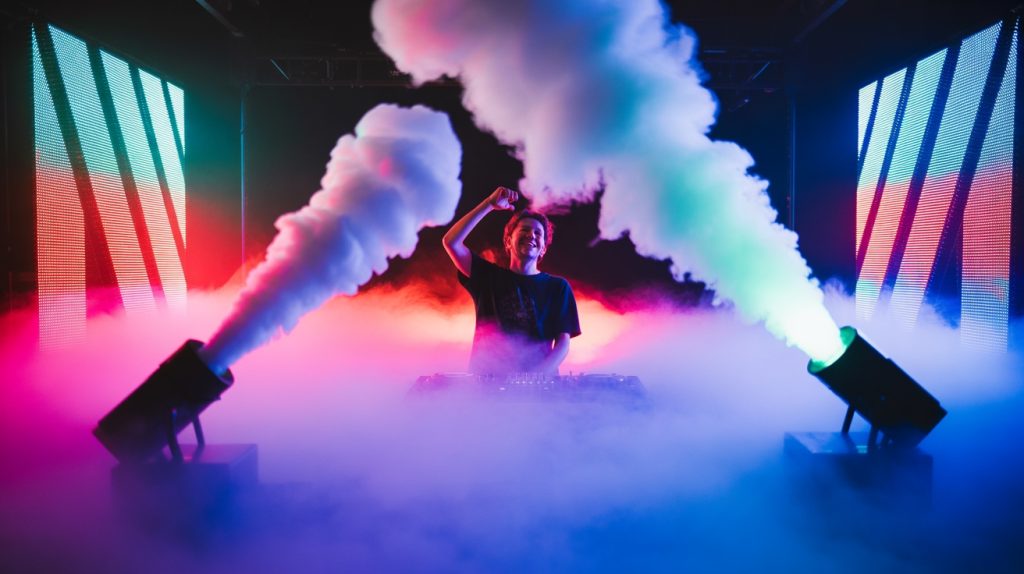
Once you’ve mapped your venue’s airflow patterns, position your primary fog machines at upstage corners to create diagonal coverage across the performance area. This placement maximizes fog distribution while maintaining clear sightlines to your performance zone.
Strategic positioning creates layered atmospheric effects:
- Upstage corner placement – Creates sweeping diagonal fog curtains that frame your performance space.
- Mid-stage side positions – Generates horizontal fog layers that catch lighting beams at performer height.
- Downstage edge deployment – Produces rolling fog waves that cascade toward the audience.
- Elevated rear mounting – Delivers overhead fog drops that create dramatic ceiling-to-floor effects.
You’ll achieve maximum visual impact by staggering output timing between machines. This prevents oversaturation while maintaining consistent atmospheric density throughout your set. Additionally, be aware that fog machines can risk triggering fire alarms due to smoke particles, so always check the venue’s alarm system before use.
Coordinating Fog Effects With Lighting Systems
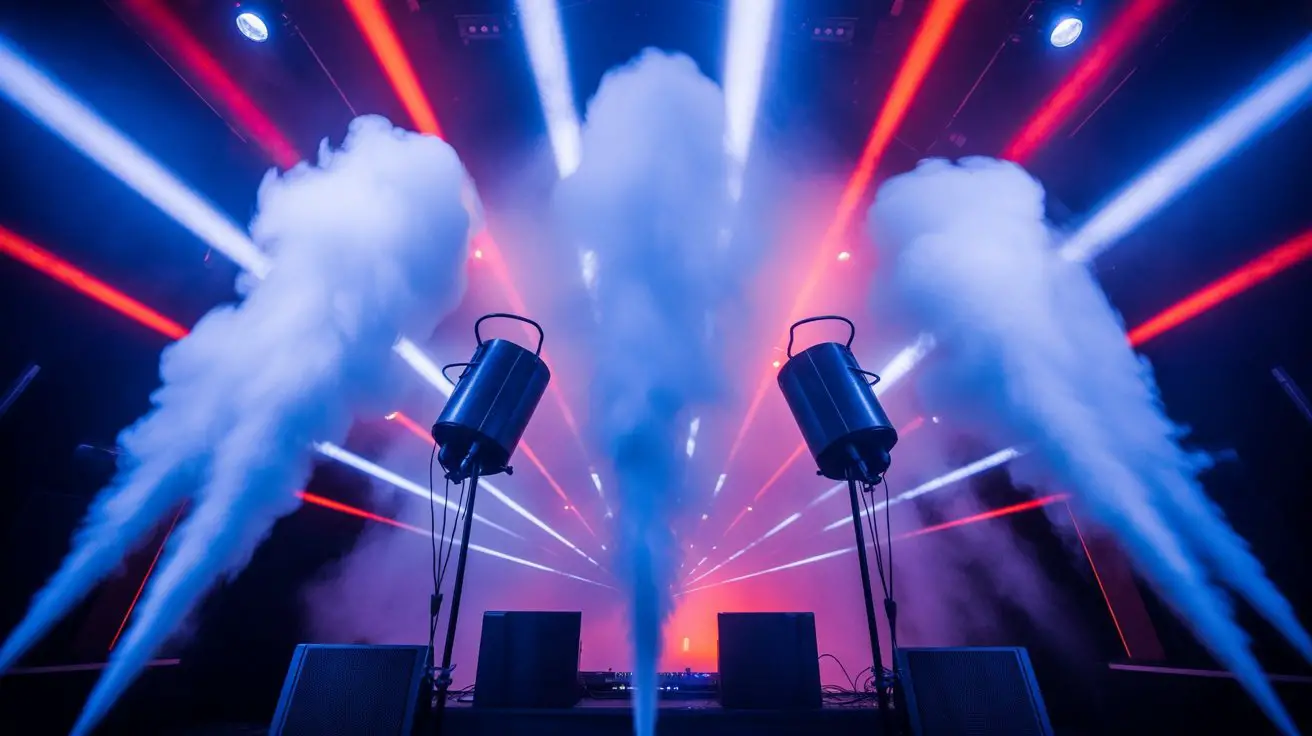
Your fog machines become exponentially more effective when synchronized with your lighting rig’s beam patterns and color temperatures. Position your haze generators to intersect with your moving heads’ throw distance, creating defined light columns that slice through the atmospheric medium. Time your fog bursts with strobes and UV wash fixtures for maximum crowd engagement. Additionally, using fog machines strategically can enhance the overall experience by creating immersive environments that captivate the audience.
| Lighting Type | Ideal Fog Density |
|---|---|
| Moving Beam | Medium-High |
| LED Wash | Low-Medium |
| Strobe Effects | High |
| UV/Blacklight | Medium |
| Laser Systems | Low |
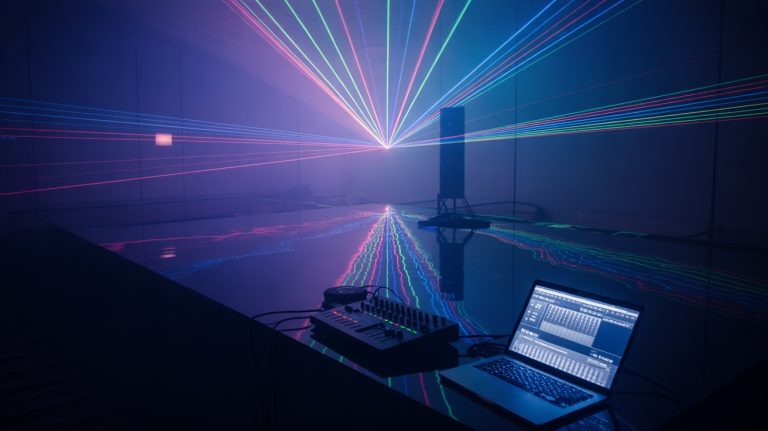
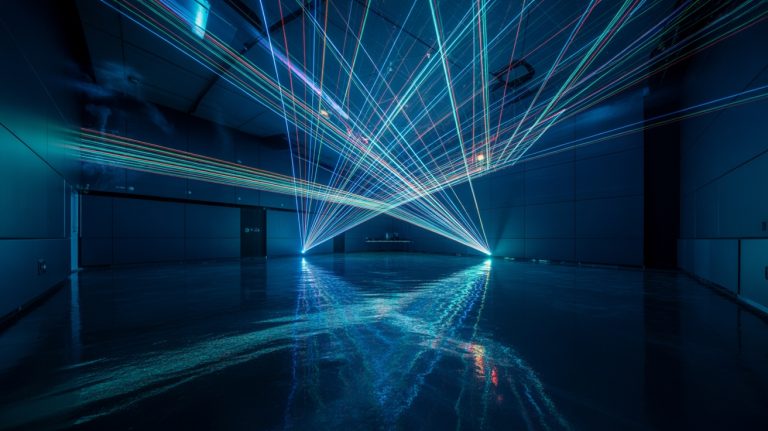
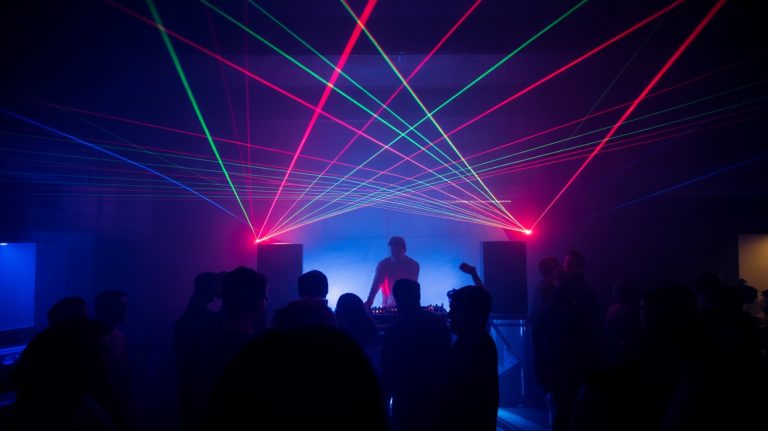
You’ll want your fog machines’ output timing synchronized with your DMX controller’s lighting cues. Pre-program fog triggers thirty seconds before major lighting sequences to achieve proper atmospheric buildup. Remember that excessive fog density will diminish laser visibility while enhancing beam effects from conventional fixtures.
Timing Your Fog Release for Musical Moments
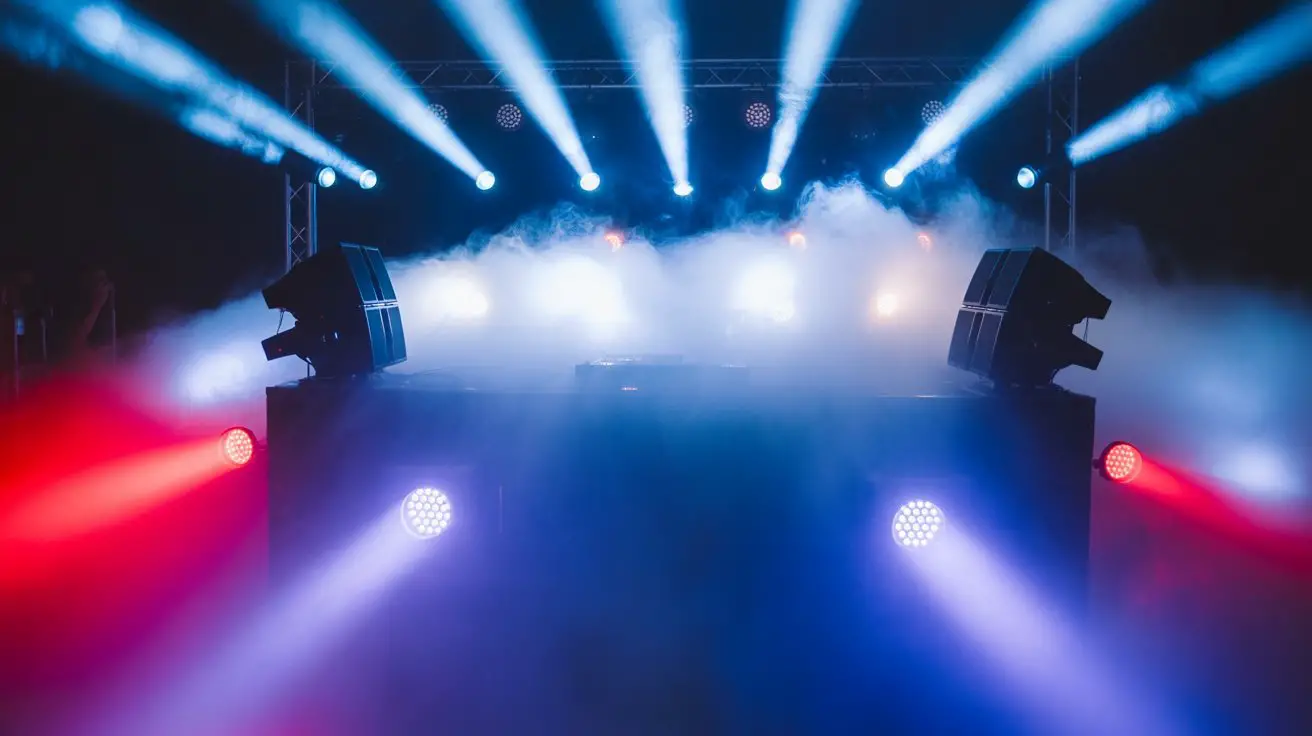
When the build-up reaches its peak and the drop approaches, you’ll need to trigger your fog machines 8-12 beats before the climactic moment to guarantee ideal atmospheric density. This pre-timing compensates for the fog’s dispersal rate and assures maximum visual impact when the bass drops.
Master these essential timing techniques:
- Breakdown anticipation – Deploy fog at 75% build intensity to create suspenseful atmosphere
- Drop synchronization – Release dense bursts 3-5 seconds before peak frequencies hit
- Vocal emphasis – Trigger subtle haze during prominent vocal lines for ethereal effects
- Bridge shifts – Use gradual fog release during genre changes to maintain energy flow
It’s crucial to be aware of the potential health risks associated with fog exposure, especially for those with respiratory conditions.
Program your fog controller’s DMX channels to respond automatically to your track’s BPM and structure.
Manual override remains vital for spontaneous crowd reactions and unexpected track selections.
Managing Air Circulation and Crowd Flow

Strategic fog placement requires careful consideration of your venue’s HVAC system and natural air currents to prevent atmospheric effects from dissipating too quickly or overwhelming your audience.
Position machines perpendicular to main air circulation patterns rather than directly opposing them. You’ll need dead zones—areas with minimal airflow—for ideal fog retention. Install machines upstream from your target zones, allowing natural convection to carry effects forward.
Monitor crowd density patterns throughout your set. Dense crowds create thermal updrafts that lift fog prematurely, while sparse areas allow pooling. Adjust output accordingly using DMX control or manual timers.
Consider venue architecture: low ceilings trap fog longer, while high ceilings require increased output.
Install fans strategically to direct fog horizontally rather than allowing vertical dispersion, maximizing visual impact at audience eye level. Additionally, ensure adequate ventilation to minimize health risks associated with prolonged exposure to fog machine smoke.
Multi-Machine Setups for Large Venues and Festivals
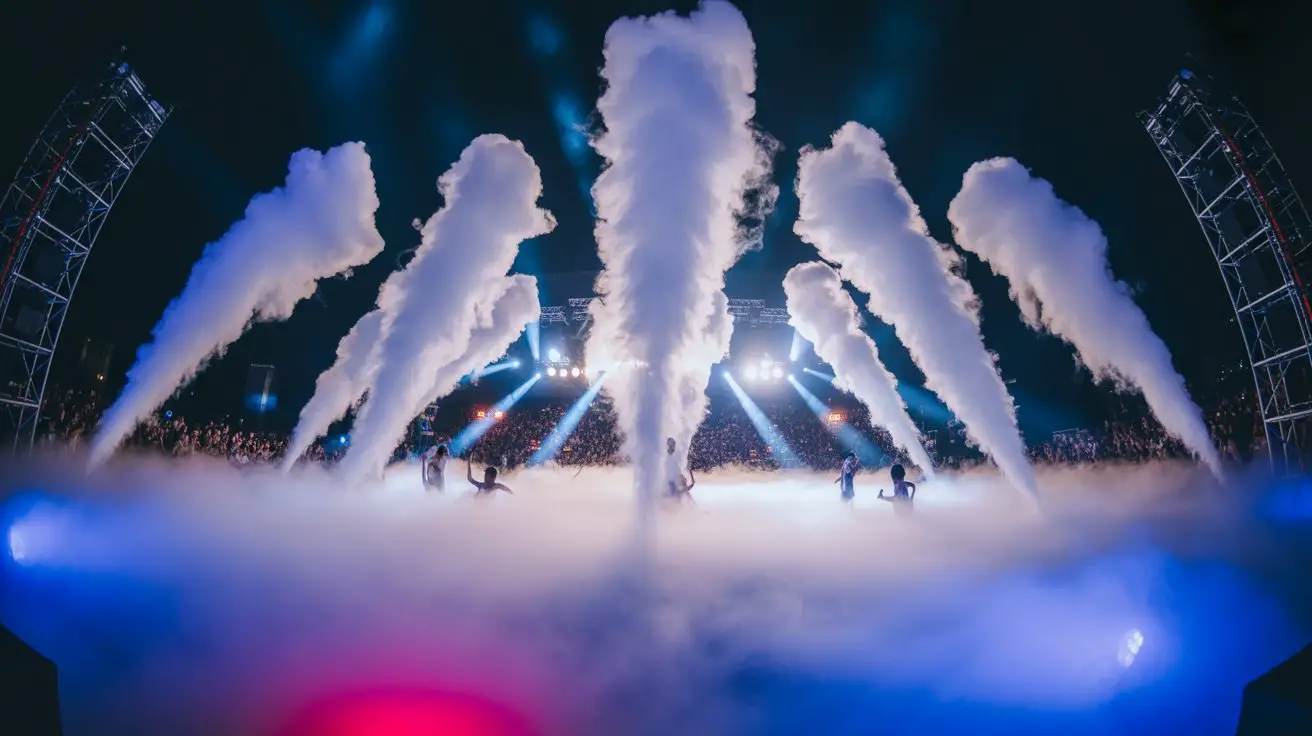
While single fog machines suffice for intimate venues, large-scale productions demand coordinated multi-machine arrays to achieve uniform atmospheric coverage across expansive performance areas.
Your festival deployment strategy requires strategic positioning across multiple zones. Install synchronized units at 50-foot intervals along stage perimeters, ensuring overlapping coverage patterns eliminate dead spots. You’ll need DMX-controlled timing to prevent oversaturation while maintaining consistent density levels.
Configure your multi-machine network using these tactical placements:
- Upstage Center: Primary haze machine for continuous backdrop layering
- Stage Wings: Low-lying foggers creating dramatic side sweeps across performers
- Crowd Barriers: Audience-level units pushing atmospheric effects into festival grounds
- Elevated Towers: High-mounted hazers distributing fog across massive crowd expanses
Coordinate fluid consumption rates and refill schedules across all units. Your timing controllers should stagger output cycles, preventing simultaneous depletion while maintaining seamless atmospheric changes throughout extended festival sets.
Frequently Asked Questions
What Type of Fog Fluid Creates the Thickest, Longest-Lasting Effects?
You’ll want high-density glycol-based fluids with heavier molecular weight for maximum opacity and hang time. Professional-grade formulations like medium or heavy density produce thicker, longer-lasting effects than standard water-based solutions.
How Much Does It Cost to Rent Professional Fog Machines for Events?
You’ll pay $50-150 daily for basic hazers, $100-300 for mid-tier units, and $200-500+ for high-output machines. Factor in fluid costs ($20-40/liter) and potential delivery fees when budgeting your event’s atmospheric effects.
Are Fog Machines Safe to Use Around People With Asthma or Allergies?
You’ll need water-based fog fluid instead of oil-based solutions for asthmatic guests. Glycol-based formulas can still trigger reactions, so you should maintain proper ventilation and position machines away from seating areas to minimize respiratory exposure risks.
How Long Does It Take for Fog Machines to Heat up Before Use?
You’ll typically wait 3-5 minutes for glycol-based units to reach ideal operating temperature before vapor production begins.
What’s the Difference Between Fog Machines, Haze Machines, and Smoke Machines?
You’ll find fog machines produce thick, low-lying clouds using water-based fluid, haze machines create fine atmospheric particles for light beams, while smoke machines generate dense theatrical effects using oil-based or dry ice solutions.
Conclusion
You’ve proven the theory that fog machine placement directly correlates to crowd engagement levels. When you’ve positioned your hazers at ideal upstage corners and synchronized your DMX-controlled output with your lighting rig’s beam angles, you’ll witness measurable increases in dancefloor energy. Your strategic placement creates that immersive atmosphere where punters can’t distinguish between the music’s physical presence and the fog’s visual extension—that’s when you know you’ve achieved proper atmospheric saturation.